
UNACCOMPANIED MIGRANT CHILDREN INVOLVED IN CRIMINAL PROCEEDINGS
INDEX
1. Children in Migration and how it Affects Criminal Proceedings
1.1. Assessments in the Asylum and International Protection system to ensure well-being, identification of victims and determination of age
1.1.1. Anti-trafficking Organisations assessment
1.1.2. Age Assessments
1.2. Legal Representatives and Persons of Trust
1.3. Mixed feelings regarding Reception Centres
1.4. Turnover and lack of continuity affects information
1.5. Lack of cultural mediators
2. Individual Assessment in Criminal Proceedings
2.1 Victims of Crime
2.1.1. Overview of Individual Assessment for Victims of Crime
2.1.2. Human Trafficking Framework
2.2. Suspects of crime
2.2.1 Overview of individual assessment of child suspects or accused of committing a crime
2.3. Psychologist assessment
2.4. Age Assessment
2.5. The Particular Role of Lawyers in Assessments
2.1.6. Promising role of the Guardians: the good and the bad
3. Pre-trial Phase
3.1. Individual Assessments of Victims of Crime(Directive 2012/29/EU)
3.1.1. Lack of coherent aim to the different individual assessments
3.1.2. Guidance not detailed enough on how to conduct assessments
3.1.3. Unclear Procedural Steps of assessments conducted with the assistance of experts
3.1.4. Unclear Time limits
3.1.5. Formal and informal Coordination
3.1.6. Training efforts but not mandatory
3.1.7. Right to Information and right to translation
3.1.8. Location of assessment based on where operation happens
3.1.9. Child’s best interest
3.1.10. Gender
3.1.11. Covid-19
3.2. Suspects or Accused of committing a Crime
3.2.1. Aims of individual assessment
3.2.2. Assessment by USSM
3.2.3. Coordination
3.2.4. Right to Information
3.2.5. Right to translation and interpretation
3.2.6. Right accompanied by person they trust and creating such trust
3.2.7. Covid-19
4. During Trial Phase
4.1. Victims of Crime
4.1.2. Aims of Individual assessment at trial
4.2. Suspects or Accused of committing a Crime
4.2.1. Judge assessment and weight of USSM report
4.2.2. The report of the USSM at trial
4.2.3. Contestability and involvement of children drafting the report of the USSM
4.2.4. Involvement of USSM at trial
4.2.5. Training juvenile judge
4.2.6. Right to be accompanied and children’s best interest
4.2.7. Covid-19
Executive Summary
The research aims to analyse the situation of unaccompanied children who are victims of crime or are suspected or accused of having committed a crime in Italy. This is a part of the Child-Friendly Justice: Developing the Concept of Social Practices project (CFJ-DCSCP), which focuses specifically on the individual assessment process in criminal proceedings and connected matters to improve access to justice of unaccompanied children. It looks at theory, policy and practice to enable the development of an individual assessment model specific to unaccompanied children in criminal proceedings, whether as victims or suspects or accused of committing a crime, so that practices on this topic can be improved.
Unaccompanied children, upon their arrival in Italy, are supported by a network of organisations and institutional figures. This includes a range of assessments conducted by these organisations, namely: reception centres to assess their well-being, early identification of victims of human trafficking and adoption of prevention strategies of deviant behaviour; interviews also suggest that anti-trafficking organisations play a fundamental role for the emersion, protection and social integration of the person, as well as bridge with social workers from the reception centre or the prosecutor office for victims of human trafficking. Findings suggest that these assessments inform and influence individual assessments performed in criminal proceedings by psychologists, prosecutors and judges. Interviewed criminal justice actors suggested this interaction and cooperation is helpful to understand the unaccompanied children and their vulnerabilities. However, this exchange is informal and dependent on initiative and good-will of those involved due to lack of protocol or procedure in this regard. Even if there was, lack of financial resources and investment in reception centres and their teams have a negative impact on their stability, resulting in staff turnover. This has implications on the information maintained and collected about the child’s personal situation, which is sent to criminal proceedings. It also has negative implications on unaccompanied children’s general perceptions of the Italian system and authorities. Nonetheless, despite deficiencies, when done well, the social workers from the reception centres, the voluntary guardians (introduced by art.11 Zampa Law) and the cultural mediators have a clear role in supporting unaccompanied children, both in the pre-trial and trial phases, as long as there is adequate coordination with the participation of the child.
Unaccompanied children who are victims of crime undergo ordinary criminal proceedings, which do not have explicitly regulated individual assessment in the same way as prescribed in Article 22 of Victims’ Rights Directive (Directive 2012/29/EU). To be sure, transposition of the Directive introduced further guidance for identification of victims with particularly vulnerable conditions, as well as a need to adopt, with the aid of a psychologist or another qualified personnel, specific protection measures during hearings and cross-examinations. But the lack of explicit procedure and regulation on what terms this assessment should be conducted results into a fragmented system. A system where different assessments can be conducted at different periods (age, identification of need of protection measures, with separate assessments at pre-trial and trial stage). Criteria and aims of these assessments are also diversified depending on who conducts these assessments, with psychologists having disciplinary guidance, whereas judges and prosecutors do not have detailed guidance for identification of measures and may apply them subject to their own discretion. This creates a situation where unaccompanied children may be subject to different number of assessments, which contributes towards a situation of stress.
Interviews suggest an effort of criminal justice authorities to involve different actors, both from the asylum and international protection system (reception centres, guardians, cultural mediators), human trafficking system (anti-trafficking organisations) to support the decision on what protective measures to apply (probative incident to prevent repeated hearings, glass barriers, video-link, etc.) to prevent secondary victimisation. This involvement, albeit promising, it is still largely informal, with anti-trafficking organisations, reception centres, lawyers and/or their guardians playing a stronger role in ensuring child victims obtain support they need. There have been initiatives, discussion and recommendations to introduce applications and digital dossiers to promote coordination between these actors working in asylum, human trafficking and criminal proceedings that can be explored further.
Unaccompanied children who are suspects or accused of committing a crime undergo juvenile proceedings, which do not have explicitly regulated individual assessment procedures, in the same way as prescribed in Article 7 of the Children Procedural Safeguards Directive (Directive (EU) 2016/800). Although, differently for victims of crime where anti-trafficking organisations, reception centres or guardians have a stronger role in ensuring support, there is a social service unit in Juvenile Courts (USSM), which have a specific mandate to guarantee unaccompanied children have access to psychology and affective assistance. Furthermore, there is a stronger focus in rules of juvenile proceedings to guarantee that decisions are made in child’s best interest, autonomy and promote their social reintegration. The main purpose of their assessment is to understand whether the child is aware of his/her actions and, if so, assigns the appropriate disvalue to what he/she has done and takes any beneficial measures in terms of protection, education, training, social integration, vulnerability and communication needs, in line with Article 7 of the Child Procedural Safeguards Directive (Directive (EU) 2016/800). The interviews showed that the social service from the juvenile system (so called Social Service Office for Minors, from now on USSM) plays a fundamental role in supporting unaccompanied children and it has been appreciated by them. Including by providing support to a judge’s assessment (art.19 Presidential Decree N.448/1988, from now on DPR), for whom hearing the child is crucial to protect him/her.
Although there is no formal guidance of how individual assessments should be conducted and what measures should be applied more broadly to promote participation in criminal proceedings. Nor reliance on a particular tool to ensure consistency, or participation of the child in drafting of reports by the social unit, which puts into question their reliability. This situation casts doubts whether the situation is in full compliance with Directive 2016/800. Stakeholder Interviews and first hand experiences of unaccompanied children, suspected or accused of committing a crime, suggest a need for individual assessments to enable an understanding of the individual and social situation of the child. Especially, since interviews seem to indicate that often involvement in crime is a reaction to a perceived deprivation of rights, tensions and lack of stability in reception centres. Situations and conditions, which also have an impact on what persons of trust should be involved in criminal proceedings.
The project wants to increase the importance of these subjects upon the proceedings, raising awareness about their role and putting them in the condition to play in a concrete and effective way for the sake of children’s best interest. The research serves the development of a model for individual assessment to be used towards unaccompanied children involved in criminal proceedings, that will help the fluency of communication among the multi stakeholder teams, the catalysation of information regarding the child and promote their participation. In addition, the organisation of roundtables or written reports with the Prefecture, University and CLEDU, the Guarantor of the Childhood and Municipality department of Social Policy can be an occasion to discuss more in detail about issues, change of perspective, judicial flow, children and professionals’ needs. The confrontation with some representatives of institutions will help identify some gaps in the system and to discuss them.
The coordination of such a variety of profiles and needs is necessary to have positive outcomes and to find solutions against the challenges that put obstacles among the unaccompanied children involved in the criminal system and the justice itself.
Introduction
Italy, over the last decades, has intermittently tried to adapt the national legislation both to EU law and to manage the migration flow. The “Child-Friendly Justice: Developing the Concept of Social Courts Practice” (CFJ-DCSCP) [1] project wants to identify the key problems affecting the access to justice of unaccompanied children, policy gaps and their drawbacks to better understand the institutional set-up as well as cultural and social norms influencing these problems. There is a need to adjust the institutional arrangements and roles for EU provisions and needs of unaccompanied children, so that the lessons learned from the implementation of the current legal framework can be used to improve the access to justice of unaccompanied children.
This report aims to analyse how individual assessments are conducted in criminal proceedings for unaccompanied children in Italy, bearing in mind the requirements of the Victims’ Rights Directive (Directive 2012/29/EU) and the Children Procedural Safeguards Directive (Directive (EU) 2016/800). As expressly set by the Convention on the Rights of the Child (UNCRC), the Article 3, paragraph 1, gives the child the right to have his or her best interests assessed and taken into account as a primary consideration in all actions or decisions that concern him or her, both in the public and private sphere. In order to ensure the child’s best interest in concrete, it is important to take into account the individual assessment of each child, on a case-by-case basis. This study will analyse both the theory and the practice when unaccompanied children participate in criminal proceedings as victims of crime and suspects or accused of committing one. It will also bear in consideration, therefore, three levels of vulnerability, which unaccompanied children are facing. First for being migrants, second for their involvement in criminal proceedings and third, depending on the impact of the different proceedings and integration, regarding social exclusion.
This is a complex topic, since participation of unaccompanied children in criminal proceedings implies the intervention of different legal systems. On the one hand, individual assessments in criminal proceedings are governed by rules prescribed in criminal procedure and criminal law. On the other hand, the system of support, assistance, integration and representation is largely governed by migration and guardianship laws. Of particular relevance in Italy is the adoption of what has been called the “Zampa Law”, [2] which is the first European legislation that proposes a “comprehensive framework” targeting specifically unaccompanied children. It recognises the special vulnerabilities of unaccompanied children and guarantees them the same rights and protection granted to Italian and other European children. It also further improves their protection, in terms of, among others, their reception and treatment. This includes the creation of new institutional figures, such as the cultural mediator and voluntary guardians.
Indeed, the migration crisis in 2015 has brought important changes from a regulatory legal framework point of view to improve the human rights situation of unaccompanied children. Before 2015, there was an uncertain and scattered regulatory system with overlapping proceedings. With the adoption of legislative decree 142/2015, [3] the reception and treatment of unaccompanied children was regulated more precisely. Particularly, the tutelary judge at the Ordinary Court became competent to appoint guardians, while the Juvenile Court was competent for the ratification of the reception measures (Article 19 of the above mentioned decree). The Juvenile Court had to assess the child’s situation upon arrival in Italian territory, and whether all the tools to protect children had been applied in line with international conventions. Specifically, verify if a guardian was appointed, psychological interviews were conducted and the presence of a cultural mediator was guaranteed, along with a placement in reception centres. Upon adoption of the Zampa Law, all proceedings concerning unaccompanied children were concentrated in front of the Juvenile Court, as tutelary judge.
To understand how individual assessments in criminal proceedings comply with the Victims’ Rights Directive and Children Procedural Safeguards Directive, necessarily requires an understanding of how these different systems interact, and how the participation of unaccompanied children in criminal proceedings is affected by it.
Accordingly, Section 1 of this report begins with a contextual analysis of select issues, processes and support that directly affect unaccompanied children in the asylum and international protection system. This will include a linkage of how what occurs in the these systems affect or has repercussions of when they participate in criminal proceedings. Such is the case, as it will be shown in this section, of specific individual assessments that are already conducted to unaccompanied children upon their arrival. Fieldwork has shown that different assessments carried out in the asylum and international protection system also inform assessments in criminal proceedings, which carry its own advantages and disadvantages. This section will also provide insights on the interaction of different roles, with a special emphasis on new or expanded institutional figures, such as the role of the (voluntary) guardian and the cultural mediator.
Section 2 will then start by providing a brief overview of the legal and institutional framework of how individual assessments are conducted in criminal proceedings in Italy. This encompasses the process of the assessment of children during the pre-trial and trial phase, who is involved, timing and how information regarding rights is provided. It offers an insight on the different professional profiles that have the competence, power and or obligation to request, support and perform an individual assessment and what tools are available. Research findings suggest that despite promising practices, the individual assessment process is fragmented and reliant on informal coordination, potentially due to lack of regulation.
Section 3 is dedicated to in-depth analysis of procedural aspects of individual assessments during the pre-trial stage of criminal proceedings. Research findings suggest a different approach depending on if a child participates as a victim or a suspect or accused of committing a crime, each with their own promising practices and concerns. For unaccompanied children victims of crime there is no explicit or specific procedurally regulated approach to individual assessments. Its accomplishment largely depends on discretionary powers of the Prosecutor and (informal) coordination with asylum or international protection stakeholders. For unaccompanied children suspects or accused of committing a crime, the situation is different, given the existence of a centralised unit attached to the Juvenile Court, who has the competence of performing assessments to support prosecutorial and judicial decision-making. A multi-agency approach from a collegial team suggests to be the most efficient one to create synergy and to guarantee the child’s best interest. Although recorded practices suggest that, there are no available tools or specific guidance to ensure consistency and coherence of assessments.
Section 4 is dedicated to an in-depth analysis of procedural aspects of individual assessments during the trial stage of criminal proceedings. At trial stage, assessment rules for child victims and suspects are similar, which include the involvement of a person providing a public social service. Although these are performed without the assistance of tools or specific guidelines as well. Moreover, judges rely on reports, which contain information collected from pre-trial and asylum and international protection system, which have their own deficiencies.
Section 5 synthesizes main findings and recommendations on how the research participants’ view an ideal model of individual assessment, always considering children’s vulnerable situation, in terms of personal profile and life experiences.
1 For more information about the project, please visit https://validity.ngo/projects-2/child-friendly-justice/ Please also visit https://www.prismonline.eu/cfj-dcscp/for the Italian webpage.
2 Law n. 47/2017 “Disposizioni in materia di misure di protezione dei minori stranieri non accompagnati”. Please check it at: https://www.gazzettaufficiale.it/eli/id/2017/04/21/17G00062/sg.
3 Legislative Decree 142/2015 “Attuazione della direttiva 2013/33/UE recante norme relative all’accoglienza dei richiedenti protezione internazionale, nonché’ della direttiva 2013/32/UE, recante procedure comuni ai fini del riconoscimento e della revoca dello status di protezione internazionale”. Please find it at: https://www.gazzettaufficiale.it/eli/id/2015/09/15/15G00158/sg.
1. Children in Migration and how it affects Criminal Proceedings
This section will analyse how the Italian system manages in practice the situation of unaccompanied children victims and suspects of crime from the time of their arrival to the start of criminal proceedings. This section will provide valuable context information regarding the vulnerable situation of unaccompanied children in the asylum and international protection system, how specific existing issues affect children and have repercussions on individual assessments and participation in criminal proceedings. The roles of different actors and multi-agency approach will be explained, based on both the experiences of the interviewees and related applicable legislation.
From a procedural point of view, upon arrival in Italy, an unaccompanied child is first identified and assigned by local institutions (Prefecture and municipality) to a reception centre, where they are supposed to stay for no longer than 30 days. In the reception centre, unaccompanied children are supported by multidisciplinary teams composed of social workers, educators, legal advisors, psychologists, interpreters, cultural mediators (internal or external), experts from international organisations, lawyers and the Director responsible for the migrant centre.
The centre’s Director is also the temporary (pro tempore) guardian until the Court appoints a voluntary guardian, according to the criterion of territorial proximity (art. 11 of Zampa Law). After these 30 days, unaccompanied children are moved to secondary reception centres called “SIPROIMI”, System of Protection for Beneficiaries of Protection and Unaccompanied Children (Sistema di protezione per titolari di protezione internazionale e minori stranieri non accompagnati), which aim at ensuring adequate accommodation for children in Italy.
Any communication and context barriers are meant to be overcome thanks to the participation of cultural mediators and interpreters. The interpreter has the role to translate children’s statements in his/her national language, while the cultural mediator helps to understand, in addition to the language, the context where children come from. They can sometimes be the same person. Cultural mediators [1] play a strong role by assisting unaccompanied children in accessing public services and even, as it will be shown, in criminal proceedings. Particularly, they assist the multidisciplinary team in the host structures, in anti-trafficking organisations and in the hospital with a psychologist or a doctor. Research findings suggest they are often well-skilled and trained, considering that participation in training courses is mandatory. Although it has been highlighted the need to integrate competence through personal self-training.
“The difficulty lies not so much in understanding the language as in understanding Italian jurisdiction, since the legal forms that exist in Italy do not exist in other countries (Female cultural mediator)”.
Statements from interviewees [2] and informal consultations confirm that the information collected throughout the asylum, international protection and integration process can be used in the criminal justice system as well, as they reflect observations of the child’s behaviour over a period of time. The multidisciplinary teams in the asylum and international protection system have an important role as they perform different assessments to understand children’s life history, identify their needs and vulnerabilities, give legal and social information to children. They inform the children about the rules in the centre, [3] the privacy policy, the right to request international protection or other permits in front of the territorial commission, the risks related to the voluntary removal, the role of the guardian, the right to family reunification if they have family living in Europe and rights of victims of labour exploitation and human trafficking. All of this information, as it will be described in Sections 2-4, will feed the process of individual assessment in criminal proceedings. Depending on what kind of assessment is conducted, different assessments and collaborations are triggered.
1 Interviews with cultural mediator, female; public social service worker; judge, female; psychologist, male.
2 Interviews with social workers from the reception centres, male; psychologist, male.
3 The rules of the reception centre are translated into the national language of the child and the child signs them.
1.1. Assessments in the Asylum and International Protection system to ensure well-being, identification of victims and determination of age
The assessments carried out by the reception centre, based on the observation of the child’s behaviour, is shared with other institutions, structures or organisations and may trigger criminal proceedings or even start additional assessments.
Interviews [1] revealed that a reception centre may trigger the need for an age assessment whenever there are doubts over the child’s age. It can be initiated based on observations of a child’s interaction with others, his/her habits or special requests, the respect of the centre rules and participation in the centre activities. Reception centres’ assessments can even lead to identification of a child victim of crime and referral to the anti-trafficking civil society organisations. Interviews indicate that there are training programmes for workers from the reception centres provided by international organisations such as Save the Children, International Organisation for Migration (IOM), and United Nations High Commissioner for Refugees (UNHCR) on how to treat unaccompanied children in vulnerable conditions and to identify a child victim based on specific indicators. In case they or the guardian notice some of those indicators, they will immediately ask support to the anti-trafficking organisation for setting up a date for a deeper assessment.
In case the workers from the centre notice some traumas on the children, they can activate the cooperation with other actors and ask for an assessment from a clinical psychologist. Recognising a disease, a trauma or any other relevant situation from the time of the arrival or immediately after helps to protect the child best interest and avoid any negative effect coming from a delay or an inefficiency of the system.
1 Interviews with social workers from migrant reception centres, female and male.
1.1.1. Anti-trafficking Organisations assessment
The professional from the anti-trafficking civil society organisation assists child victims in understanding since their first encounter on what they are entitled to, the paths they can take and the laws on trafficking, in the hope that they will understand the information, present their views and decide on course of action. During second meetings they usually start to be more open and tell a few more relevant information. During the assessment, they can have doubts about the age of the child, so in that case they inform the competent authorities to verify the child’s chronological age.
Reports by reception centres or guardian, containing age assessments, are strongly taken into account in criminal proceedings by the psychologist. Psychologists sometimes choose to integrate them and other times issue opposing views. Furthermore, the judge in charge of a proceeding during his/her assessment considers also the report prepared by other actors such as the psychologist, the social service, the manager for the reception centre. The Ministry of Interior affairs in Italy has the duty of vigilance [1] of the reception facilities and monitoring the respect of children’s rights in them, otherwise they can be involved in proceedings for compensation, as civil parties, from the lawyer of the offended person.
1 Interview with lawyer, female.
1.1.2. Age Assessments
Under the Zampa Law, an age assessment can be conducted by a multidisciplinary team, in case of uncertainty about the real age of a child or a young adult. The age is an important element to be assessed for the purposes of determining if a child’s age falls under the age of criminal responsibility (at least 14 years old), and if the case will be prosecuted in the ordinary court or juvenile court whenever a crime is committed by a child.
Zampa Law (art. 19 bis) has introduced an innovative assessment process to ascertain the real age done by a multidisciplinary team. If the doubt emerges in the reception centre, they can report it to the responsible authority (Prosecutor Office of the Juvenile Court). The child can be accompanied to the hospital by the police, the guardian, the cultural mediator, educator or another professional from the reception centre if needed, for the multidisciplinary assessment introduced by Zampa Law.
The law requires identity procedures to be carried out on arrival of an unaccompanied child in Italy, and an inquiry to be conducted to determine what future actions will be in the child’s best interests. Where there is reasonable doubt over a child’s age, age determinations may be carried out, but should use the least invasive methods possible. Identification procedures should be concluded within ten days and be carried out in primary reception facilities. Facilities must meet minimum standards to ensure the child is adequately accommodated and their fundamental rights protected. [1]
The multidisciplinary approach represents a guarantee for the child and turns into an important wider cognitive moment, where the psycho-social investigation gathers information to reconstruct the congruence with the declared age. Different professionals such as a pedagogue, a neuropsychiatrist, a gynaecologist, a social worker, a psychologist contribute to the assessment and the results will be included in a multidisciplinary report for the Prosecutor Office of the Juvenile Court, integrated in its content by the observations made by the workers of the reception centres (social workers, educator, manager or any other) over a defined period of time that highlight daily behaviours of the child. There is no standard procedure to follow, but there are some parameters that are guiding the assessment, such as, for example, graphic tests. The authority can be assisted by cultural mediators. [2] The child upon this proceeding feels as his/her will is taken into consideration and their dignity is more respected as the approach is less invasive than the X-ray exam.
The Zampa Law has modified the age assessment method to require more evasive examinations only in exceptional cases, if it’s not possible to conduct the multidisciplinary method (such as can bone examination (X-Ray Exam). A lawyer can request the invalidation of the examination, whenever it does not correspond to the one methods described in Zampa Law. In front of the age assessment report prepared by the multidisciplinary team, there is the responsibility for the team itself to repeat the examination if a lawyer has requested its invalidation, but it does not always happen, as shown in the interviews from a cultural mediator. The child can be accompanied also by the cultural mediator, upon his/her request or of a professional working with him/her, for the age assessment, in order to facilitate the communication, where there are language difficulties; he/she is almost on the same level with the guardian.
These assessments tend to start upon request of other actors (reception centre, police, territorial commission, etc.) and the role of the psychologist within the multidisciplinary team is to assess the child’s age based on his/her behaviours and if she/he has in charge a child it can be interesting to investigate on the reason behind his/her change of version. The results of this further assessment are transmitted to the Juvenile Court, which modifies the date of birth.
Rarely age assessment process results from the initiative of the Juvenile Court and it appears as a procedure that identifies the range of age where the child belongs to (normally it is not precise and it can be between 2 and 3 years). As the age is mostly assessed in the pre-trial phase, the report can be used also in a proceeding concerning the child, without making again a new assessment. It is up to the judicial authority to ask new assessments.
1 Lelliot J.,Italy’s ‘Zampa’ law: increasing protection for unaccompanied children (2018). “The law provides that unaccompanied children must have access to the Italian National Health Service during their time in Italy, and be admitted to educational institutions. They also have a right to be informed about legal representation, which should be provided free of charge, funded by the State. Other articles of the Zampa law amend or introduce procedures regarding family reunification, the provision of residency permits, access to foster care, the training and appointment of guardians, and assistance for victims of human trafficking. The law also provides for the creation of a national information system, which is designed to keep track of unaccompanied children in Italy and includes information on their location and their individual needs”.
2 Interview with judge, female.
1.2. Legal Representatives and Persons of Trust
Interviews have shown that multiple actors who play a legal, supporting or assisting role in the integration of unaccompanied children, are involved in criminal proceedings as well. This is sometimes either a legal requirement, fulfilment of a voluntary role, or as result of a trust relationship developed with children.
First, we have the role of the voluntary guardian, who has the legal responsibility for each unaccompanied child and is the legal representative of the child in any proceeding regarding him/her (art.11 Zampa Law). Although the responsible director of the reception centre [1] is the child’s temporary guardian from the time of their arrival until the Juvenile Court appoints a voluntary guardian from a list created by the Child Protection Authority in the Juvenile Court. This list is composed of citizens who participated in a specialised training course. [2] The role of voluntary guardian was an innovation introduced with the Zampa Law, whereby a list of specialised citizens fit to fulfil a guardian role of unaccompanied children was created. The appointment of a guardian is not linked to the conduct of the child, it is not a rewarding protection [3]. The guardian is not paid and he/she has the obligation to identify instruments with respect to each child in a flexible manner, but this concerns the respect of the child’s individuality.
The appointment of the voluntary guardian is done on average in 2 weeks from arrival, but there have been cases where it has taken more than a month. The voluntary guardian must accompany and support the child from a legal, health, regulatory and educational point of view. The position of a temporary guardian of the responsible person, from the reception centre where the child is hosted, covers the period of time that is needed to let the Juvenile Court appoint a voluntary guardian and it is incompatible with the profession of worker from a reception centre, due to a conflict of interest. Whenever there are no voluntary guardians available, the Court can exceptionally decide to appoint, as a guardian, the mayor of the city or a representative member of the municipality where the child is placed. In turn, if the mayor or representative are not able to ensure constant support to the child, they use to give a sub-delegation to the responsible of the reception centre, that in practice will support the children but officially the mayor or another representative remain the guardians appointed. [4]
The educators, working as professionals within the reception centres, are responsible for facilitating the child’s integration process, to organise activities within the centres and to arrange the school attendance for the children. The educators play a role even during criminal proceedings as they can eventually (it is not legally required, but it is an option upon request of the child/young adult) accompany the child to the assessment in front of the judge, the USSM or even during the age assessment. Since in the reception centres school attendance is not mandatory, educators ensure at least that unaccompanied children attend the CPIA (Provincial Centres for Adult Education) school for adults, starting from literacy and then they can get the eighth grade diploma.
Finally, the role of the cultural mediators does not vary depending on whether the child is a victim or a suspect of crime and is meant to help the child to understand the Italian and the origin context. Moreover, the cultural mediator may participate in hearings or processes in criminal proceedings, upon request of the competent actors intervening in the different phases, where the child is expected to intervene to provide assistance in this regard.
1 Interviews with social workers, female (Managers of reception centres for unaccompanied children).
2 The training can be offered by the local institutions (Guarantor for children and adolescents) or organisations (in Palermo, for example, Unità Organizzativa Casa dei Diritti or Istituto Don Calabria) together with international organisations such as UNHCR, CIR or UNICEF.
3 Interview with lawyer, female (also appointed as voluntary guardian).
4 Interviews with social workers, female; public social assistants, female; Managers of reception centres, female and male.
1.3. Mixed feelings regarding Reception Centres
To further put into context what happens in criminal proceedings it is important to look at their experiences in the asylum or international protection procedure. Indeed, their interaction with Italian authorities, experiences and treatment in administrative proceedings expose additional vulnerabilities that should be taken into account in criminal procedure and can affect their perception of the Italian system.
In some cases, the stakeholders involved in the integration are really motivated by solidarity values, while in other cases economic interest prevails. While in some cases it was suggested that the centres are safe places, with a stable team able to establish a good and trusty relationship with the child over a period of time, in other cases it was suggested that they become like a prison for children, cause of stress, exposing the child to deviant behaviour.
Some interviews with lawyers and social service workers revealed that the lack of funds to reception centres, which contribute to lack of adequately competent and stable staff teams, create conditions of uncertainty in the child’s environment, which makes them feel lost. In more extreme situations, where a child is deprived of their rights has resulted in at least one violent incident. Case in point, a one-time incident where an unaccompanied children became a suspect of aggression [1] towards a social worker of the reception centre where he/she is placed in reaction to a deprival of his/her right to receive every two weeks an allowance.
1 Interview with young adult, male: “I got angry, I broke the door and I was speaking loud to that person. So for this episode the operator made a complaint to the police”.
1.4. Turnover and lack of continuity affects information
In many cases, the information given within the reception centre is considered inadequate in terms of skills, as they sometimes are not trained enough to face certain specific situations. Furthermore, some interviewees have reported that staff in centres are not always careful about the needs of vulnerable people, as the training opportunities received may not cover certain topics. Most of the interviewees agree that the given information has to be complete and transparent. Particularly, the role of each team member has to be clear and each of them should be provided training to ensure proper information transfer, and make them able to address the children’s needs. The ability to transfer complete and exhaustive information [1] towards the unaccompanied children has been linked to the attendance of training courses and to the presence of a stable team. The training courses for the workers from the centres and other organisations are given in a compulsory way by bodies such as UNHCR, IOM, EASO or Save the Children and they aim to raise awareness about their role.
From the interviews with a lawyer, a Prosecutor and social workers, emerged some critical observations regarding the management of the reception centres, because the team is not stable and there is a lack of continuity, competence and experience. Therefore, the children’s future could be compromised and the system could waste resources. This instability may have repercussions on how the criminal proceedings go, how the information is delivered or the behaviours and choices the children will make in front of the competent authorities.
These two cases show that if the children were well informed about their rights within the Italian system, they could be better prepared to prevent being exploited. They also highlight the need for further vigilance. The first case concerned a proceeding for labour exploitation of unaccompanied children within a reception centre where they were allocated. They have been working, without regular contract, on a land for cultivation owned by the person responsible for the reception centre and the other workers were aware of that. They were either not paid at all or paid with biscuits; another case concerned unaccompanied children allocated in the reception centre who have been working, without regular contract, in a restaurant of the responsible property, all day long, getting paid 50 Euros per week. The criminal conducts were discovered by some workers from “Save the Children” that made a complaint to the police, they started investigations and the reception centre was immediately closed.
1 Interviews with lawyer, male; prosecutor, female.
1.5. Lack of cultural mediators
Each team should have more cultural mediators -as underlined by different professionals from the reception centres, the psychology department and the anti-trafficking body- as they contribute to a better understanding of the proceedings, both for the professionals and for the children themselves. However, due to lack of economic resources this professional profile is often missing. In these cases, an external expert or a mediator from another body can be contacted for a specific case as a consultant (for example if the USSM needs the support of a cultural mediator, they can ask the reception centre where the child is placed, if they have one available).
2. Individual Assessment in Criminal Proceedings
Having provided background and context of what occurs in the asylum and international protection system and vulnerable situation unaccompanied children are found, this section is focused on providing a brief overview of individual assessment procedures. It includes crosscutting observations on stakeholders involvement both in general criminal proceedings and juvenile proceedings in Italy, following the chronological order of intervention, whenever.
Both Directive 2012/29/EU and Directive 2016/800/EU establish minimum standards for individual assessments of victims of crime, which includes children, and child suspects or accused of having committed a crime. There are different expectations of compliance with the two Directives. In particular, explicit legislative measures were taken to transpose the Victims’ Rights Directive, which included vulnerability assessments at different stages of the ordinary criminal proceedings [1]. On the contrary, no new measures were introduced to transpose the Children Procedural Safeguards’ Directive, since it was considered by the State not necessary. [2] This study will however reveal, despite a degree of transposition and/or implementation, more work still has to be done in regards to individual assessments in criminal proceedings for unaccompanied children in Italy.
Whenever unaccompanied children become involved with criminal justice proceedings, there is an intersection between different legal frameworks of support, assistance, protection and individual assessment from asylum and international protection area, from special human trafficking legislation and other frameworks for other crimes in general. Even these different legal frameworks vary according to the status of the child in the criminal proceedings, whether involvement happens as a victim of crime or as a suspect or accused of having committed a crime.
In Italy, child victims and child suspects or accused of committing a crime are involved in different criminal proceedings. Child victims of crime participate in what is generally called ordinary criminal procedure, which is regulated by Italian criminal procedure code and criminal law, without prejudice to referrals to complementary or specialised legislation. Child suspects or accused of committing a crime participate and are prosecuted following a specialised juvenile justice procedure, regulated by Presidential Decree no. 488 of 1988. Each procedure establishes specific rights, guarantees, support and protection depending on the child’s role in each procedure.
Furthermore, while child victims of any age can become involved in ordinary criminal proceedings, the jurisdiction of the Juvenile court for child suspects or accused of committing a crime depend on: 1) if the child was older than 18 years old at the time of commission of the crime; 2) the child was younger than 18 years old at the time of commission; 3) if the child becomes 25 years during criminal proceedings. For the purposes of this study, this means that the relevant age range for unaccompanied children who are suspects or accused of committing a crime is between 15 – 17 years old.
Considering the above, an in-depth analysis necessarily requires both: a separate focus on the different proceedings, which are applicable to child victims and suspects or accused of committing a crime; and also the specific stages of each proceedings, given different competences, rights and obligations prescribed in the two Directives. Therefore, this section will start by providing an overview of how individual assessments are conducted based on the law, which will act as a springboard to dive into specific issues, recommendations and identification of potential good practices in Italy.
1 Legislative Decree n. 212/2015.
2 See https://eur-lex.europa.eu/legal-content/EN/NIM/?uri=CELEX:32016L0800.
2.1. Victims of Crime
The Victims’ Rights Directive regulates individual assessments in its Article 22, describing their purpose, relevant factors, and criteria to take into account and a time limit by when it should occur. There are also specific procedural requirements described throughout the directive that need to be complied with, which includes the child’s right to be informed, understand and to be understood about a right to be individually assessed, in an appropriate manner to the child’s age, maturity and overcoming any communication barriers. Decisions have to be made in the child’s best interest and a child has the right to be accompanied by a person they trust. All of these steps have to be conducted in a multidisciplinary and coordinated approach. This section starts by providing the steps listed in the law.
For victims of crime, there is a legal framework of support, assistance and protection specific to unaccompanied children to enable their integration, access to public services, integration and appointment of guardians called the Zampa Law. [1] Then there is another legal framework for the support, assistance and protection for victims of human trafficking, which covers unaccompanied children as well in Decree-law no. 212/2015. [2] It includes specific rules for identification and individual assessment for victims of human trafficking, and led to the creation of a specialised network of coordination and multidisciplinary approach between reception centres, Juvenile Courts and criminal authorities with a specific mandate on human trafficking, which is activated upon the child’s arrival. This multidisciplinary approach means that different professionals with an appropriate expertise will contribute to the assessment process in order to make it as complete and exhaustive as possible according to the child’s needs. A psychologist or neuropsychiatrist to address psychological issues, or a cultural mediator whenever the child has language or comprehension of the context issues. Finally, there is a general legal framework for the information, support, assistance, protection and a form of individual assessments under ordinary criminal proceedings, which applies to all victims of crime, regardless of the specific crime, closer to the meaning of Directive 2012/29/EU.
1 Law n. 47/2017 “Provisions on the protection of foreign unaccompanied children”.
2 In transposition of Directive 2011/36/EU.
2.1.1. Overview of Individual Assessment for Victims of Crime
The decision of the child to make a complaint is difficult because they fear for their own safety and retaliations on their families in their countries of origin. [1] A complaint filed by a child victim of crime in ordinary criminal proceedings is followed by preliminary investigations, with the assistance of the police and in coordination by the Public Prosecutor (Article 55 (2) of the Criminal Procedural Code, from now on CPC). The driving force behind the criminal process is the Public Prosecutor who is responsible for establishing whether the crime has been committed and gathering sufficient evidence to go to trial or not (Article 405 and 408 of the CPC).
The criminal procedural code does not formally regulate individual assessments. At the pre-trial stage, the Public Prosecutor conducts their own assessment during the investigation phase when hearing the child for the first time, after notification of the centre (Article 362 (1) CPC). The Prosecutor is assisted by a child psychologist or psychiatrist qualified expert (Article 362 1-bis CPC) whenever an interview involves a child victim. The psychology expert provides a report about the psychological status and makes recommendations, as demonstrated from the witnesses of the judicial authorities, and this professional plays an important role as Article 351 paragraph 1 ter and Article 362 paragraph 1 bis Criminal Procedure Code provide. The psychologists can be appointed either as experts or as consultants: it depends on whether is named by request of the judge or by request of the lawyer. The psychologist can be called to make an assessment in a separate place as a consultant or to assess the child’s behaviour even during the proceeding as an expert.
If the crime committed against the unaccompanied child is one of the crimes listed under Article 362 ter CPC (sexual crimes, including violence and exploitation, slavery and labour exploitation, trafficking in human beings, domestic violence and violence between those in intimate relationships) the Prosecutor must collect statements from the child within three (3) days of the criminal complaint. At the trial stage, the trial judge conducts a different assessment to determine the application of protective measures for the purposes of cross-examination is necessary (Article 498 of the CPC).
During the assessment led by a Prosecutor emerged that hearing the child for the purpose of cross-examination would cause a secondary victimisation [2] and put at risk his/her protection, the criminal procedure code gives the possibility to:
-
not hear the victims if there are other relevant evidences;
-
initiate probative incident, whereby a special hearing which allows the child to give evidence only once and prevent repeated interviews (Articles 392 and 398 CPC), or even;
-
take specific measures to prevent intimidation or retaliation (Article 360-362 CPC). [3]
Under the law, it prevails the objective to balance [4] the need to protect the victim and, at the same time, the defensive guarantees of the accused person.
The police, [5] before whom the complaint may be filed, is an important point of reference (art. 55 CPC) since they may act as a bridge between the Prosecutor and other actors who take care of the child, such as the guardian, the manager and the operators of the centre where the child is placed, as well as the social workers of the anti-trafficking agency. In some cases if there is a cooperative solid teamwork, where the actors are in synergy with each other, the Prosecutor could refer directly with those actors, without the mediation of the police. For example, it could happen that the Prosecutor contacts by mobile phone a social worker from the anti-trafficking body, if they work together for years in similar cases.
The information can be collected by the Police as well, assuming this task was delegated, and must follow the same safeguards as when it is conducted by Prosecutor, especially since the appointment of psychologist is done by the Prosecutor (Article 55 (2) and with the 351 (1-ter) CPC). This information collected by the police is then transmitted to the Prosecutor and included in the case file (Article 357 and 373 (5) CPC).
This situation seems to contradict Article 22 of the Victims’ Rights Directive. Rather “a” individual assessment to identify specific protection needs, and/or to determine special protection measures in the course of criminal proceedings, due to the child’s vulnerability to secondary and repeat victimisation, to intimidation and to retaliation (Article 22 Directive 2012/29/EU) there are multiple assessments at different stages. At pre-trial stage, during preliminary investigations, such as age assessments (Article 90-ter CPC), an assessment to determine the need for a “probative incident” [6] (Article 392 and 398 CPC), an assessment of measures to prevent intimidation or retaliation (Article 362 1-bis CPC) and, at trial stage, another assessment to determine the application of protective measures for the purposes of cross-examination (Article 498 of the CPC).
1 Interviews with young adults suspect, male; victim of crimes, female.
2 Gialuz M., Lo statuto europeo delle vittime vulnerabili (2012).
3 In hearings with children an audio-visual system is used (Article190 bis, paragraph 1 bis Criminal Procedure Code). The child and/or lawyer can make a request to carry out a probative incident (Article 392), The art. 190 paragraph 1 bis CPC blinds the possibility to repeated statements, unless there are new elements to take into account. It takes place in a protected way, using the mirror glass (Article 398 paragraph 5 quarter CPC). Similar protective measures can be applied at trial stage (art. 498 paragraph 4 quarter CPC).
4 Lorenzetto E., Il diritto di difendersi indagando nel sistema processuale penale (2013).
5 Article 55 CPC (par 2) states that: “the police do any activity delegated or ordered by the judicial authority. It offers a function of support of the judicial authority in the investigation phase, it’s inherent to its role to facilitate the communication with other actors involved.
6 Special hearing with enhanced protective measures that enables vulnerable victims to provide testimony in criminal proceedings. When this occurs, generally there is no need for repeated hearing in the trial stage. The rationale for this is to prevent secondary victimization.
2.1.2. Human Trafficking Framework
With regard to child victims, interviewees have suggested that the most common crimes under which unaccompanied children fall victims [1] are trafficking in human beings and labour exploitation. However, given lack of disaggregated statistics the full scope of the situation is difficult to grasp. This situation helps explain why most of the experience that will be described and analysed in following sections relate to practices under special human trafficking law.
Interview sessions, assessing all the relevant circumstances and the child’s needs, are conducted in a separate place from the anti-trafficking body. At the first interview with the child victims, the anti-trafficking civil society organisation provides information to the child, eventually together with his/her voluntary guardian if requested by the child, about the victim’s rights, the permits they ask for, the protection programmes they may join, the protection anti-trafficking centres they may be moved to. The child victims of human trafficking are normally assisted during the interview by a cultural mediator of the anti-trafficking organisation, who speaks their language and in some cases they have lived the same situation in the past, so it helps to create a relationship with them and to let them feel less uncomfortable.
The child can be heard several times for the assessment conducted by the anti-trafficking organisation in their office, giving priority to the child’s needs. If the child at the first interview doesn’t want to talk, his/her will is always respected; if he/she shows some traumas, the psychologist service can be activated, as in the case there are language issues, a cultural mediator is put at disposal of the child.
In the case of pre-trial assessments, observations and evaluations are provided, according to a multidisciplinary approach, by the operators of the reception centres where the child is placed after his/her arrival, by different actors involved at different stages of the criminal proceeding. The multidisciplinary approach means that different professionals with an appropriate expertise will contribute to the assessment process in order to make it more complete and exhaustive (i.e. the child could be affected by psychological issues supported also by a psychologist or a neuropsychiatric doctor, he/she could have language and comprehension of the context issues so to be supported also by a cultural mediator).
The multidisciplinary team for victims of human trafficking and other forms of violence includes the IOM (International organisation for Migration) field expert, who receives the victim at the moment of the arrival and makes the first information, the specialised guardian who is appointed by the Juvenile Court, the Juvenile Court for the civil proceedings, the police and the Public Prosecutor for the investigations, the workers of the reception centre where he/she is first placed for the first, the anti-trafficking agency and the psychology department with specific competence in migrants who have lived horrific traumas due to this new migratory pathway, social workers for providing access to different services, interpreters and/or cultural mediators for language and cultural context understanding support.
1 Save the Children, Piccoli schiavi invisibili (2017).
2.2. Suspects of crime
To contextualise the information in this report, it is noted from interviews and statistics that cases involving child suspects or accused of committing a crime are relatively low. Perception seems to suggest most common crimes involved are against property, possession and distribution of drugs and assault in accommodation centres. There have been also rare cases of trafficking in human beings, as they were accused of inducing children in their country of origin to engage in prostitution, arguably to get rid of their condition of victims. Two unaccompanied interviewees, who participated in juvenile proceedings as a child, suggest that, beyond smuggling, unaccompanied children tend to be involved in offenses committed within migration facilities.
In recent years, in the district of Palermo where this study was conducted, there was an increase of proceedings involving unaccompanied children. For what concerns criminal proceedings in 2020, [1] there were 431 cases involving unaccompanied children; 51 sentences were pronounced at the end of the trial and there are still 60 trials pending to be decided for the same year. The types of offences for which they use to be suspect are: assaults within the reception centres where the children are located for not handing over pocket money, threats, declaration of false personal details; they use to be solved with a judicial pardon or with the irrelevance of the fact. Then there are the cases of probative measures, which are not numerous: less than 10.
If the child is a suspect of crime, the Juvenile Court is the competent jurisdiction and special juvenile criminal proceedings are followed (Presidential Decree no. 448 of 1988). It is a specialised criminal process, whereby all professionals involved are expected to have specific skills to take into account the process of development and growth of the child. Its general principles require that the decisions of its proceedings is to be made in line with the personality and educational needs of the child (Article 1 DPR no. 448 of 1988).
1 Interview with judge Juvenile Court, female.
2.2.1. Overview of individual assessment of child suspects or accused of committing a crime
An important role regarding individual assessments is played in these by the Juvenile Justice Services, the so called Office of Social Service for Minors) (USSM Ufficio di Servizio Sociale per Minorenni), a body which assists the Juvenile Court, as art.6 of the Presidential Decree states. They intervene to take charge of the child, following a mandate from the judicial authority, at different stages of the proceedings, depending on whether the case is pending before the judge of the preliminary investigations, the judge of the preliminary hearing or the judge of the trial and they follow the whole process.
Their role, in synergy with other actors, such as the reception centre operators, is to ascertain upon juvenile criminal proceedings the child’s personal characteristics, psychophysical maturity and other elements such as elements about “personal, family, social and environmental conditions and resources of the child in order to ascertain the their degree of criminal responsibility, assess the social relevance of the fact as well as arrange the appropriate criminal measures and adopt any civil measures” (Article 9 DPR n. 448 of 1988). In order to understand children’s legal capacity, their capacity to understand and their capacity to decide by themselves, their eventual psychological traumas, it is requested support intervention by the territorial services, such as child neuropsychiatry and the mental health department.
While the mandate for a specific case is given by the Juvenile Court, it is the USSM, which performs individual assessments, with the support of other municipal services. Their findings are included in a report and transmitted to the judge presiding the case. In addition to individual assessments, the USSM also assures affective and psychological assistance, with, whenever possible the involvement of the guardian or other suitable person indicated by the child (Article 12 PD no. 448 of 1988).
2.3. Psychologist assessment
Based on the child’s statements and behaviours, the psychologist is called from the Prosecutor to prepare a report where to reconstruct the child’s personal history and to show if there are vulnerabilities and the reasons behind that. The assessments of the psychologist are based on a clinical analysis of a child. Based on interviews with psychologists, first, there is a practice where they inform the child about their rights and their assessment in different ways, such as reading to the children all the documents concerning them (for example a decree from the Court). Psychologist Interviewees also reported a practice of confirming or asking them questions to ascertain that everything is clear to make them understand the information. Interviews suggest there is a shared belief, in line with the Victims’ Rights Directive and Children Procedural Safeguards Directive, that a child’s best interest requires to inform the child and to help children understand each step of the proceeding.
During the assessment they can be assisted by a cultural mediator, which, according to interviewees play an important role for the comprehension not only of the language, but also the context where the child arrives and comes from. This service is carried out for free.
The assessment by psychologist does not follow a standard procedure, [1] but it is carried out on the base of what the child narrates. There are no differences in the procedure to follow, whether the child is a victim or a suspect, or is subject to repeated victimisation or secondary victimisation or in case of personal/familiar intimidation or retaliation, but any consideration related to these last aspects have to be reported.
Interviews indicate that psychologists are bound in any case to deontological codes, and disciplinary approaches that provide some direction and flexibility to accommodate unique cases and backgrounds. Every session is different. This factor, remaining within the boundaries of a rigorous ethics, according to the interviewees with a psychologist, allows the psychologist to take the best from each session. If there are elements not falling within the biographical frame or the personal sphere, then more information can be asked. This process, according to interviews, can take a long time. In most of the cases, the children repeat the same statements, as it was a script, not revealing easily new relevant information. They can be closed and suspicious at the beginning, sometimes they ask to be accompanied by the operators of the reception centre, if they feel reassured by them. [2]
1 Interview with psychologists, male and female.
2 Interview with psychologist, female; social worker, male.
2.4. Age Assessment
An age assessment [1] can also be requested to ascertain the age of a person victim (Article 90 (2-bis) CPC) or suspect upon criminal proceedings (Article 67 CPC and Article 8 Presidential Decree no. 448 of 1988), if there are doubts. An age assessment is initiated by the Public Prosecutor’s Office at the Juvenile Court [2], who proceeds with the necessary investigations following a multidisciplinary method introduced by the Zampa Act (art. 19 bis). This age assessment [3] is carried out by several professionals from a multidisciplinary team, in collaboration with hospital personnel such as gynaecologists, psychologists, paediatricians or child neuropsychiatric doctor. Following this examination, the assessments are included in a final report to be forwarded to the Public Prosecutor’s Office of the Juvenile Court to confirm the child’s age.
If during any proceedings, the child is qualified as such, without contestation, and there are no well-founded reasons to consider otherwise as Zampa Law states, the Public Prosecutor does not request it. Notwithstanding, interviews suggest that Public Prosecutors’ may initiate this without the request of any party in the proceedings. For example, it happened that a young girl was prosecuted in ordinary criminal proceedings as an adult perpetrator and then, while in a centre for adults, she revealed she was younger than 18 years old. [4] She had been found in possession of documents as an adult. The Prosecutor, in these cases, has charged another office in another region where she was located, to carry out a multidisciplinary age assessment. At the end of that assessment, it emerged that she was of minor age and the data were forwarded to the Public Prosecutor’s Office.
Interviews also suggested that children might also be induced to lie by smugglers themselves. Former unaccompanied child [5] victim of human trafficking indicated that they were obliged by the traffickers to declare at the arrival in Italy that there are up to 18, because the child’s age is an aggravating factor that can increase the penalty for the offence committed, from one-third up to two thirds.
Failing to identify a child’s age from early on, may lead to injustices. A particular worrying case was of a young unaccompanied adult, convicted for smuggling in the Ordinary Criminal Court of Trapani, who spent two years in prison. After making an appeal in front of the Appeal Court, an age assessment was disposed from that Court. Currently he has a trial pending in front of the Juvenile Court for the age assessment, as he declares that at that time he was under the age of 18. If confirmed, this case shows how age identification done late can cause negative consequences on the child/young adult life. There is a need to prevent cases like this one, which flags the need for better awareness of child assessment processes even in criminal proceedings for adults.
1 Especially in the pre-trial phase as emerged from most of the interviews.
2 Di Napoli E., Riflessioni a margine della nuova procedura di accertamento dell’età del minore straniero non accompagnato ai sensi dell’art. 5 della legge 47/2017 (2017).
3 La Placa S., Approvato il protocollo multidisciplinare dell’età di minori stranieri non accompagnati (2020).
4 Interview with Public Prosecutor, female.
5 Interview with male young adult accused of smuggling.
2.5. The Particular Role of Lawyers in Assessments
It is only mandatory for a lawyer to be appointed when a child is a suspect of crime. While for child victims it is not mandatory, and it might depend on the will of the guardian and the child himself/herself. An interview with a lawyer suggests that it is important to maintain good communication between the guardian and lawyer, in both pre-trial and trial phases to ensure the child’s best interest is protected. [1]
Whenever the guardian is also a lawyer, [2] there is no provision for the appointment of a lawyer for the victims. He/she may appoint even another person for providing legal assistance and, in this case, he/she would receive all the legal notifications in the residence of the appointed lawyer. The role of the lawyer is to execute the law, to make requests or forward applications for example for international protection, to receive notifications, to claim compensation if the injured party takes part in the civil action. Lawyer can also become one of the main point of contact if for example a victim does not wish to become involved in proceedings:
“I did not want to know anything about the proceedings. The only person I was talking with was my guardian/lawyer” (quote, female unaccompanied child victim).
Particularly relevant, the lawyer may conduct its own assessment and make requests for application of protection or beneficial measures, such as a probative incident (Article 392 and 398 CPC), petition the Prosecutor to initiate age assessments, petition protection measures at trial. The way to conduct the lawyer’s assessment is not standardised, each lawyer follows his/her method, as it is not a codified procedure and it is ruled only by broad principles. Some of them only listen to the child’s story, while others write it down in some notes. The first assessment serves to collect the information at disposal of the judge, to charge the services responsible for investigating a discomfort (insomnia, for example) or the “transcultural” psychiatry service to protect the child from an emotional point of view.
A lawyer can request independent assessments, especially when there are doubts on the reliability or completeness of information found in reception centre reports, USSM reports, psychology reports, etc. Such is the case of an interview, [3] where it was highlighted the importance to meet the child, to understand what the child’s interest is, to highlight parts that remained unclear in the story from the police report and to identify any particular needs (for example a particular vulnerable condition that requires a psychological assessment).
Interviews suggest that lawyers have an interest in reconstructing the case and must assess the child’s personal life history. Similar to an investigator, in order to prevent harm to the child as possible. The lawyer’s assessment of the concrete case must be carried out as soon as the mandate is granted, having the focus on the child’s needs and the seriousness of the crime. The information collected is included in the party’s file and can be produced in court thus becoming part of the ex officio folder. It can be collected as notes or orally, it is not mandatory to produce the results of the lawyer’s assessment in a report. If needed for the child defence, the lawyer can ask the professionals involved since the pre-trial phase, as witnesses during the proceedings.
Fieldwork however has revealed that lawyers’ direct involvement with children varies. Often the public defender does not even meet the child but only relates to his or her guardian. The reception centres and the organisations have within their team lawyers as well. Within the organisations, for example at the anti-trafficking civil society organisations, the lawyer intervenes only if the child victim requires it and does not participate in assessment of the child situation. Fieldwork has also revealed complains that lawyers and social services often have difficulty communicating. If the lawyer is not well informed and provides distorted information, it strongly influences the result of the proceeding; if the social service misses something, the child will be proven to have information due to him or her; it is also the guardian’s responsibility to inform himself or herself in order to give the right information to the child. The environment in which they take place is safe, normally at the professional’s office or the reception centre. Depending on how the lawyer prepares the defence he/she influences the decision of the judge and the child’s statements have a greater weight because he or she is the person directly concerned.
As for training, they are supposed to be highly specialised and the Criminal Chamber of each district used to offer two-year qualifying courses focusing on juvenile defence.
1 Interview with lawyer, female.
2 Interview with two lawyers/guardians, female.
3 Interview with lawyer, female.
2.1.6. Promising role of the Guardians: the good and the bad
It is unclear how widespread this practice is, but interviews suggest that guardians have facilitated the participation of children in criminal proceedings by clarifying to child victims the information provided by other actors and by helping to understand procedural rules. [1] Interviews with guardians suggest different approaches to transmit understandable information, such as: using simple vocabulary, bearing in mind the child’s needs; prompting the child to confirm his/her statements; repetition of information; providing examples drawing from the guardian’s personal experience.
While the role of guardians can be a potential beneficial force for the child, not all guardians play an active role according to interviews. The relationship between the child and the guardian is based in many cases on minimal communication, either because they (the guardians) are absent or because the child is not interested in building up a relationship. Some guardians but also the social assistants from USSM underlined nonetheless the importance to be present, as they are a fundamental trait d’union between the institutional side and their cultural background [2].
It often happens that children do not speak out and keep silent, if they think that everything is up to them. In any case, a fundamental role during the proceeding was played by the guardian appointed and a person from Save the Children, as they gave her the courage and support to overcome the fear and worries [3].
It is not a legal requirement for a guardian to be present during the assessment conducted by, for example, an anti-trafficking organisation, unless the child requests so. Although in more extreme cases, it was noted that the guardian actually never met the victim.
Those who intervene must be specialised, aware of their role and the information they give. This does not always happen for the guardians, the social service providers, the workers from the reception centres of other organisations.
1 Interview with lawyer, female (also appointed as voluntary guardian) and social workers working also Managers of reception centres.
2 Interview with social assistant, female and with a lawyer, female (also appointed as voluntary guardian).
3 Interview with young adult accused of crime, male.
3. Pre-trial Phase
Legal analysis and fieldwork has revealed deficiencies of the procedural measures that enable a form of individual assessment of children. This section will analyse the practice, bearing in mind existing legislation and corresponding gaps during pre-trial stage. For the purposes of this report, pre-trial is defined as from the moment criminal justice authorities are informed of the existence of a crime up until the confirmation of charges for the purposes of leading a case to trial. In Italy, this includes, preliminary investigations and preliminary hearings to confirm or dismiss charges.
As it will be shown in the following sections, there are reasons for concern on how the Directives have been transposed (when at all) or how they are actually being implemented in practice. As pointed out before, there is convergence between different specific legal frameworks in Italy due to unaccompanied children specific situations and the type of crime they tend to be involved in, are relevant during the pre-trial stage. This explains this section’s analytical focus on migration law (Zampa Law), human trafficking law (Decree law no. 212/2015) and Criminal Procedure Code and Criminal law, against Directive 2012/29/EU for victims. For suspects, practice under Zampa Law, DPR n. 488/1988 is going to be analysed against Directive 2016/800/EU. Therefore, this section will have a separate analysis of these two target groups, in specific stages of the criminal proceedings.
3.1. Individual Assessments of Victims of Crime (Directive 2012/29/EU)
As explained in the previous section, during preliminary investigations there is no explicit regulation of a formal procedure to conduct individual assessments, as understood in Article 22 Directive 2012/29/EU. Legislation and practice suggests that assessments are carried out as part of adaptation of existing criminal processes, to collect evidence and carry out purposes of prosecution. Does this actually lead to a full compliance with the Directive?
3.1.1. Lack of coherent aim to the different individual assessments
The different assessments at pre-trial, while laudable, are generally anchored to evidentiary processes though. An important indicator of this is that the Prosecutor is only meant to collect information “relevant to the investigation” (Article 362 (1) CPC), and for the necessary exercise its powers to indict or not the defendant (Article 326, 358, 405 and 412 of the CPC).
As revealed in an interview with prosecutors and judges, there is no standard procedure to follow in each situation assessment, [1] but each proceeding can be conditioned by different factors depending on how serious the crime committed is, the child’s needs, the information collected in the pre-trial phase and many other factors. He/she has to make a preliminary assessment about the offence, on a case-by-case basis and it is the fact committed that makes the assessment process change. There are no predetermined criteria in place, but every aspect has to be supported by evidence to prosecute. It follows a logic of preserving evidence, when there is the risk to lose them or to take some decision or action (for example if a girl, after the arrival, has the phone number of the potential trafficker, the police immediately contacts the Prosecutor to initiate wiretapping, if needed). All the information collected is normally included in the judicial folder, which should not contain reports concerning the child, unless it was asked for a psychological report.
To be sure, a rationale of the probative incident and determination of protection measures to prevent encountering the defendant, intimidation and retaliation (Article 360-362, 392 and 398 CPC) is similar to what is required in the Victims’ Rights Directive. Albeit the Italian law is more limiting. There are three contradictions of the Italian criminal procedure law, in terms of the purpose they serve and the aims of the Victims’ Rights Directive. A reading of the objectives of the Directive as a whole demands: 1) individual assessments to ensure participation in criminal proceedings as a whole, not to specific hearings, since these must contribute towards ensuring victims “receive appropriate information, support and protection” (Article 1 (1) Directive 2012/29/EU), not only protection; 2) best interest of the child must be a primary consideration, and also, “assessed on an individual basis” (Article 1 (2) of the Directive 2012/29/EU. Regrettably, while laudable, these two assessments are insufficient to be fully in compliance with the terms of the Victims’ Rights Directive.
With the introduction of Decree law no. 212/2015, transposing the Directive 2012/29/EU criminal justice, professionals must infer if a victim has any “particular vulnerable condition”. Interviews with prosecutors [2] suggest this should be identified already during the first hearing of the child with the assistance of a psychologist (Article 362 CPC). Although it is unclear if it this is a general practice as there is a lack of regulation, aim and guidance to it. And there is reason to be concerned, considering the first hearing with a Prosecutor is regulated towards obtaining evidence to substantiate a decision to indict or not.
1 Interview with Public Prosecutor, male.
2 Interviews with Public Prosecutors, female and male.
3.1.2. Guidance not detailed enough on how to conduct assessments
There is no detailed guidance on how these assessments should be conducted in law. Article 90 quater of the Criminal Procedure Code [1] introduces a description of what is called “particularly vulnerable condition”, [2] in its paragraph 1. From this definition, “particular vulnerability” is inferred on the basis of a series of subjective and objective elements: age, infirmity, mental deficit, the type of offence being prosecuted and the circumstances of the act being prosecuted, emotional, psychological or even economical dependency to the offender. The paragraph lists several crimes such as trafficking or labour exploitation.
Despite helpful guidance found in the definition of “particular vulnerability” in the determination of a “particularly vulnerable condition”, which might motivate the application of protective measures during preliminary investigations and during cross-examination at trial (Article 498 4-quater), there are different issues. First, the law still lacks how exactly prosecutors or judges are supposed to infer or interpret, coherently and consistently these different factors and criteria. Second, among the list of crimes in Article 90-quarter it is missing gender-based violence sexual violence, which are listed in the Victims’ Rights Directive (Article 22 (3)). Third, rather than adopting the broader term “personal characteristic”, Article 90-quarter only lists some specific, albeit personal, characteristics, such as age, state of infirmity and mental deficit, which leaves out characteristics such as foreign nationality, ethnicity, gender and other types of disabilities.
1 Introduced with the Decree n.212/2015, transposing Article 22 of Directive 2012/29/EU.
2 Tamburini G., La tutela della vittima di reato: l’accertamento della condizione di particolare vulnerabilità (2018).
3.1.3. Unclear Procedural Steps of assessments conducted with the assistance of experts
The law requires the usage of qualified personnel, such as child psychologists or child professionals to assist in the process of collecting statements and information from a child victim of specific crimes. These are sexual crimes, trafficking in human beings, domestic violence, violence in intimate relationships, slavery and forced labour (Article 362 1-bis and Article 351-ter of CPC). If they are not involved, the lawyer can invalidate the proceeding. Their role is to allow the judicial authority to read the gesture language or to facilitate the communication in case of language issues. It is not a legal obligation for prosecutors to rely upon psychologists for other crimes, although a public prosecutor has the power to call any necessary experts.
The prosecutor and police may collect information and reports from reception centres and other figures who are supporting the unaccompanied child. There is discretion [1] on the weight the Prosecutor puts in of the different assessments, which might depend on the child perspective and on the personal relationship built up with each actor.
The psychologist or an expert in neuropsychiatry who follows the child since his/her arrival, mostly outside the proceedings, can also be involved, upon request of the judicial authority, also in the pre-trial phase, when a child is heard, as a consultant during the preliminary hearing that assists the Prosecutor Office in understanding the child’s way of communicating or as a consultant to whom the prosecutor ask to carry out a psychological investigation on the child to understand his/her experience, the traumas, the factors that could interfere with his/her ability to tell [2]. The expert, psychologist or neuropsychiatric doctor must be assigned by the Public Prosecutor or the Judge at trial, normally through a decree, to make a three months assessment in order to assist that person. In the assignment, it must be specified what the expert is called upon to do and what the limits of his/her work are and what the value is in that case.
1 Interview with Public Prosecutor, female.
2 Ibidem.
3.1.4. Unclear Time limits
No provision of the criminal procedure code clarifies at which stage of the criminal proceedings the condition of particular vulnerability can be determined for a child victim of crime, nor when exactly an individual assessment should be conducted for the purposes of the Victims’ Rights Directive. To be sure, the Victims’ Rights Directives only clarifies that the assessment must be “timely” and in any case at the “earliest possible opportunity” (Article 22 (1) and Recital 55).
Age assessments are only meant to occur whenever there are doubts or uncertainty about the child’s age. Assessment of vulnerability, protective needs and determination of protection measures is unclear. If, as interviewees suggest, that a first assessment occurs during the first hearing with the prosecutor the procedural code only establishes a time limit of within 3 days of complaint for specific crimes listed in Article 362 (1-ter)(sexual crimes, human trafficking, labour exploitation, slavery, domestic violence and violence in intimate relationships).It is not clear for other crimes however.
3.1.5. Formal and informal Coordination
Since there is no formalised procedure for an individual assessment in ordinary criminal proceedings, the coordination of it and the determination of when a victim can be identified as having a “particularly vulnerable condition” is unclear and under which procedural subject it must be declared: whether by the prosecutor, the judge, the judicial police at the beginning of the investigation or by other subjects (e.g. social services that have contacted the police or from whom, for example, a report has been made, etc.).
Among actors in criminal proceedings, interviews suggest at least informal dialogue among all the other actors who play an important role in the proceedings. This includes dialogue between actors in the migration field, namely guardian, reception centres and even the child’s lawyer [1], who also perform their own assessments. Especially whenever the crime is trafficking in human beings, there is at least informal contact between the prosecutor and anti-trafficking organisation, and different actors tend to update each other orally. Any important information is kept also in a written form (either on paper and/or in a digital format) by the competent authorities.
Whenever the case concerns a victim of human trafficking however, Decree no. 212/2015 foresees a more formalised support network coordinated by the anti-trafficking organisation. The support to the child victims of human trafficking includes before or after a trial, to join a protection programme to start a new life with the supervision of the centre of protection where they will be hosted. The programme is usually activated under initiative of the reception centre where he/she lives.
Promising Practice: Social workers from the anti-trafficking body in Catania, in cooperation with other actors and reception centre staff, created an online app for communication and exchange purposes -where personal data of each beneficiary are entered and constantly updated with info related to support and work carried out, or on events that occurred to be considered. In other cases they just call each other [2].
Despite some promising initiatives, the lack of a compact team for child victims of any crime, including unaccompanied children can compromise consistent efforts to assist, support and protect children as required under Article 22 of the Victims’ Rights Directive. It seems that the lack of personnel, more in the public sector than in the private one, is one of the causes for which the system is slow and the multidisciplinary teams are incomplete, as suggested by interviewee with social service from USSM.
1 Interview with social assistant, female (also an institutional guardian of several unaccompanied children).
2 Interview with social worker, female (migrant reception centre professional).
3.1.6. Training efforts but not mandatory
Depending on who is involved and their role in the assessment and proceedings, there might be specialised training. The anti-trafficking body is composed by educators, social workers, lawyers, cultural mediators) who attend internal training courses within the anti-trafficking system, to be updated on current actions, how the phenomenon changes from territory to territory and applicable laws but it is not mandatory.
It is unclear if this training translates to other actors in proceedings, especially whenever trafficking in human beings is not involved, namely prosecutors and judges. Ultimately though, when assessments are conducted by psychology professional, the law demands that they are properly trained.
3.1.7. Right to Information and right to translation
The information about rights and duties are provided orally by the professionals that intervene in different phases of the proceeding. In the interviews with Prosecutors, it was underlined that their role is to make children understand what their role is as an authority, what will happen if the child talks, where he/she is heard, who sees him/her. There is a mutual need to know, so that the need of information matches with the right because the child has the right to be informed because he/she has the resources to understand it, the actors involved will have to use a language that he/she can understand. Treating the child as a person who needs to be informed and advised but also to understand in order to make choices is a duty of loyalty, regardless of whether the law provides for it.
Interviews suggest caution in exchange of information at the beginning of the investigations, for human trafficking victims. Experience suggests unwillingness to cooperate due to various reasons, such as personal and familiar threats by perpetrators or fear for the uncertainty of the judicial outcomes, for not telling the truth or for saying one thing and then saying another or for keeping silent, so if you can, you avoid hearing from them. Information is sometimes provided in a fragmented way, sometimes as a team.
Some interviewees [1] say that information about the different phases of the proceedings should not be given at once because it is important to build a relationship slowly and to let the child have time to be aware about an action or a decision concerning him/her; other professionals say that the information should be given with due awareness and being sure that the child has understood it [2].
Whenever unaccompanied children do not understand the language of the proceeding, they can be supported by a cultural mediator and/or an interpreter. Albeit it does not occur often, different interviewees (lawyers, prosecutors, judges, psychologists, social services, responsible from reception centres and guardians) underlined the importance of the role of the cultural mediator, not only for translation needs but mostly for the mutual need to understand the Italian context for the child and the origin context for the professional. Only in a few cases the presence of the cultural mediator was considered as an obstacle for the communication fluidity, because it can break the conversation, so in these cases the professionals could avoid it using a vehicular language (English or French).
Although practice suggests that information about right to individual assessment is provided at the initiative of some actors, such as psychologists, there are concerns if this is a standard practice. Especially because, right to be informed about individual assessment is not listed under Article 90-bis, which lists the information that criminal authorities are obligated to provide.
1 Interviews with lawyers, male and female.
2 Interviews with psychologist, female; and social assistant, female.
3.1.8. Location of assessment based on where operation happens
As emerged from the different professionals’ interviews, about the places where the assessments for victims and suspects are conducted in the pre-trial phase: in the office of the professionals that are dealing with the children such as the anti-trafficking body office, the reception centre where he/she is hosted, the social service office. Sometimes being in a comfortable place does not help to reassure the children, while a cold and grey office often negatively influences the child’s behaviour.
There is no specially built place to conduct the assessment by law. In practice, they essentially tend to happen in the office of the stakeholder that is conducting the assessment, with the conditions available to them.
For Prosecutors, the assessment is made at the venue where the interviews take place. The guardian and the institution inform the child at their offices or in the guardian’s office; if the Public Prosecutor wants to hear him/her, he/she will do so in the place designated for the hearing. Not necessarily the prosecutor’s office but a more welcoming place. There is not a suitable place for all children. Depending on the way and the moment the questions are asked, some mechanisms can affect the genuineness of the story, which could compromise the whole procedure [1].
1 Interview with lawyer, female.
3.1.9. Child’s best interest
Interview with the prosecutor points out that it is necessary to understand if the child is ready to speak, in the interlocution with the other actors. If the child is not ready, the probative incident should not be done in order not to damage the child and the proceedings’ results. Sometimes, from a global assessment of the guardian and the anti-trafficking agency, the Public Prosecutor reasonably decides not to do the probative incident in the name of the child’s best interest and to hear the victim at the preliminary hearing because it is necessary that some time passes. There is no protocol that predetermines how to proceed, situations are very different and each person is a particular case. Reality always surpasses fantasy, and one has to be flexible in order to adapt and understand what to do.
3.1.10. Gender
The Prosecutor with the police has the faculty to choose a person as interpreter and it was confirmed by different professionals during the interviewees that an interpreter of the same sex and the same ethnic group of the child would be preferred. He/she can create a relationship of empathy with the child that could reduce stress factors, although he/she must only translate what the child says during the hearing.
3.1.11. Covid-19
During the Covid-19 crisis, the assessments from the anti-trafficking body have continued face-to- face in the most urgent cases and via video call in the rest of the cases, only if all the necessary guarantees can be respected [1], in terms of reducing potential reluctance elements given by the embarrassing situation, protecting the child’s acknowledgement of his/her identity but also the privacy about the topic of discussions. For example, the child hosted in a centre can be heard via video call, only if the workers from that centre can fully guarantee his/her protection and privacy. However, the communication efficacy was limited due to the missed inter-personal interaction, the screen of the device creating relational distance among the parties.
During the lockdown period, the psychology department interrupted the face-to-face meetings because the office was closed.
In courts and prosecutor’s offices, during the Covid-19 period, the hearings were also suspended and have not been followed up in online modality, via videoconference.
1 Interview with social worker, female.
3.2. Suspects or Accused of committing a Crime
This section will include an in-depth analysis of individual assessments of child suspected or accused of committing a crime, bearing in mind the requirements of Children Procedural Safeguards Directive. This while bearing in mind the specific vulnerability of child suspects of crime related to their life experiences and migration project (pre-departure and in-transit), inclusion and being at risk of deviance as they are often physically and emotionally neglected.
As noted, a case involving child suspected or accused of committing a crime in Italy follows juvenile proceedings and is prosecuted by a Juvenile Court. Concerning individual assessments, an important role is played by the social service of the Juvenile Justice System (USSM). More broadly, USSM also has a role in restorative justice and its social workers have in charge children involved in the criminal circuit and young adults up to 25 years of age for crimes committed in childhood. [1] Social services in Palermo are divided into units, depending on the type of crimes they deal with.
The USSM teams, both in Rome and Palermo, involve only female workers. According to an interviewee opinion, a women team can facilitate a dialogue with the child, as it happens with the Albanians or South Americans. They maintain respect on a formal level because it has recognised the institutional aspect of the social services together with the Court. A report of this synergy can be prepared from the USSM (as referred from the Palermo Office).
1 ISTAT, Data on offenders and offended persons, depending on gender, nationality and age (2019).
3.2.1. Aims of individual assessment
Article 7 of the Child Procedural Safeguards Directive establishes a right to individual assessment for children who are suspects or accused in criminal proceedings. It serves to: 1) determine any specific measure to the benefit of the child is to be taken; 2) assessing the appropriateness and effectiveness of any precautionary measures in respect of the child; 3) take any decision or course of action in the criminal proceedings, including when sentencing. In particular, to take any beneficial measures in terms of protection, education, training, social integration, vulnerability and communication needs (Recital 18, 35, 48 and 55 of Directive 2016/800/EU).
It is clear both from the law and reported practice that the USSM conducts assessments and takes measures to assist the child in the form of affective and psychological assistance (Article 6, 9 and 12 of PD no. 448 of 1988). Public prosecutor and judges also conduct specific assessments where they acquire elements about personal, family, social and environmental conditions and resources of the child in order to ascertain the degree of responsibility, assess the social relevance of the fact as well as arrange the appropriate criminal measures and adopt any civil measures (Article 9 no. 448 of 1988).
However, there are doubts whether these aims are in full compliance with the Directive. Specifically, the only agency with an explicit mandate to conduct assessment to apply beneficial measures is the USSM, while public prosecutors and judges’ assessment aim is essentially for the purposes of prosecuting, punishment and within this scope applying measures that meet educational needs, and arguably social integration needs. Even within the aims of assistance, it is not clear if the agency goes as far as conducting an assessment encompassing vulnerability, protection and communication needs more broadly.
Practice does suggest that the USSM adopts a multidisciplinary approach seeking to provide assistance that the child needs. It would be helpful if law consistently reflected this aim, especially to ensure assessments for beneficial measures are consistent and comprehensive regardless of the particular background and needs of the child and support effective participation.
3.2.2. Assessment by USSM
The assessments carried out by the USSM serve to gather information on the child and are kept in a file in paper format (as a social file) but also electronically in a national database and are functional to the preparation of the report for the Court. They use to follow the guidelines applying for the social service in general and thanks to their experience in the field they have developed some types of questions that they use to repeat during the assessments. All the data collected flow into a report pursuant to Art. 9 of the Juvenile Criminal Code (personality investigation), which includes not only information on the personality but also resources on the environmental, social and family level. This report becomes part of the case file, and is used by judges, for example, in the preliminary hearing to assess whether or not benefits can be granted.
The first interview is carried out by the professional educator, possibly in collaboration with community workers, the social services of the municipality, the psychologists of the prison medicine service to make appropriate assessments and take charge at a psychological level, social mediators for the procedures to be activated at a health level, cultural mediators and the guardian. The guardian is often present also during institutional passages as well as in court hearings. Fieldwork does not suggest the usage of a specific tool to conduct these assessments.
3.2.3. Coordination
Collaboration between stakeholders is coordinated by the USSM (the social service of the tribunal), asks for consultations to all professionals dealing or that have dealt in various stages with the child. Multidisciplinary team includes a variety of stakeholders: lawyer, the Juvenile Court, the police, the social service providers from the Juvenile Centre of Justice, USSM and the social service providers from the municipality where is located the centre where the child is hosted, workers from reception centre already involved in a pre-trial phase, the guardian, the psychology department from the hospital, other organisations, interpreters, cultural mediators. As noted, all the information collected by USSM will be part of its own report, which will be part of the case file.
USSM works in synergy with other actors of the criminal proceedings for whom alternative measures, community penal measures, precautionary measures and probationary measures can be applied. There is a continuous interaction between all the services within their specific competences.
They work in a network with the guardians, if present and active, the social services of the municipality (social policy department) but also with the internal services of the Ministry of Justice so that the criminal experience of the child does not limit the interruption of the educational and training processes in place. In addition, the network also includes private social organisations (communities), socio-health services of the public hospital (in the case of neglected pathologies such as for example syphilis, tuberculosis for those who lived in conditions of neglected health and accommodation or in the case of girls, they may need to abort a pregnancy or contraceptives, specific gynaecological visits).
The social services of the municipality have a role in understanding the path to be followed by the child in order for the proceedings to be concluded, as well as in taking care of the new adult in the cases referred to in art. 13 of the Zampa Law, which provides for an administrative continuation until the age of 21 in order to guarantee the activity of integration in the territory and training. The multidisciplinary team, composed of workers from the reception centres and guardians, who support unaccompanied children, play an important role in adopting prevention strategies. The prevention can be ensured by a high-specialization of all the actors involved in the pre-trial and trial phases, by a complete and clear transfer of information, by the preliminary identification of particular vulnerable subjects at risk of deviance and who have suffered traumas, through the individual assessments and observations made on their behaviours and features. [1] Interviews suggest unaccompanied children willingness to continue to benefit not beyond the age of 21 from the support of the operators and remain in the centres. The judges try to make them understand the importance of continuing the paths started and eventually the guardianship becomes regulated by art. 13 of Zampa Law if the child has given his consent. Once they reach the age of 18, many of them move away from the reception centre and, as the experiences from the interviewees have demonstrated, they are easily not traceable once they escape.
The most serious case recorded in this study concerned a Ghanaian boy who set fire to the centre where he was hosted. In that situation the social service together with the cultural mediator played an important role to understand which problems he had, in which community he had been placed and from which he had been taken away. Their assessment showed that his disorder was caused by the use of drugs. In that case, it was decided as a penalty for the arrest. [2]
The young adults interviewed felt well considered and their point of views were taken into consideration for their best interest. In one of these cases, the interaction between the social service and another organisation such as Doctors without borders was necessary to support a young who was feeling alone and lost in Italy.
1 Save The Children, Sviluppo di metodi transnazionali basati sui diritti del minore diretti alla prevenzione della criminalità minorile e alla promozione del reinserimento sociale. Italia, Grecia, Romania (2008).
2 This last example represents an exceptional case because the Italian system provides that only in extreme cases a child accused of crime can be arrested.
3.2.4. Right to Information
The unaccompanied children [1] in this phase should be informed and supported by all the workers from the reception centres(educators, legal advisors, cultural mediators, social workers), his/her guardian as the legal representative and a psychologist upon request, especially in the pre-trial phase. They received all the information orally and even the written reports are read and explained together with other professionals, such as the psychologist, the social service, the legal operator from the reception centre, the cultural mediator, by the lawyer or the guardian. They are not trained for this specific purpose.
Right to information upon arrest
It is important for the child suspect to be heard by a judge who is able to understand his/her way of expression and to formulate questions in a proper way. The judges integrate the information since their first meeting, that in some cases it coincides with their first point of contact with the justice system, but it can be postponed also in different moments: for example, if the child is arrested at the hearing to validate the arrest or at the hearing directly. This information is given orally, usually at the first hearing or after in another hearing and they use a simple vocabulary to facilitate the child’s understanding. About the content of the information it refers to the role of the judge and the possible outcomes of the trial (i.e. who they are, what they are doing, why criminal proceedings have been opened, rights and duties of the child, etc.)
If the child has been detained, within 96 hours the hearing to validate the arrest is held by the judge for preliminary investigation that orders the precautionary measures which vary according to the seriousness, such as pre-trial detention in prison, pursuant to Article 23 DPR 448/1988, when there is a risk of the child escaping from the reception centre.
Actors involved in giving information for suspects
Interviews suggest that a child’s reaction and attitude upon the proceeding could be conditioned in a positive way by all the teamwork giving complete and clear information about what is going to happen at any phase of the proceedings. The information about the proceedings can be given by the lawyer, by the staff from the reception centre, by the guardian, by the judge, by the social service USSM and/or from the municipality, as actors of the proceedings that involve unaccompanied children suspects of crime; it can be given in different moments, depending on how the proceeding starts.
Techniques to confirm understanding
The information is complete and effective if the child reacts with a collaborative attitude upon the proceeding. It is not enough to give some information pro forma, but each professional should verify that the child not only understands the language but also the complex Italian system and the reason behind the application of some legal decisions.
In the cases where the two young adults interviewed, they understood the proceedings circumstances, thanks to the explanation efforts made by the judicial authorities but also other professionals such as a cultural mediator, a legal advisor of the centre or the social assistants responsible for their case. Although it was noted it was not mandatory to ascertain that the child has understood the information given, it is relevant that the information is communicated and reiterated, asking to the child explicitly to confirms or repeats what she/he understood. [2]
A fluent communication helps an effective participation of the children and other actors in the proceedings, as it has emerged from a social perspective of a psychologist [3] and from the legal perspective of some lawyers [4]. There is general agreement among interviewees that receiving and understanding the information provided (starting from the basic rules to the adopted measures by the judicial authority) is the main condition to participate with awareness in all the proceedings concerning them [5]. It is important to understand that an individual approach has to be adopted taking into account each child’s needs.
1 Interviews, social workers/temporary guardians active in two different reception centres, male and female.
2 Interview psychologist, female.
3 Interview psychologist, male.
4 Interviews, two male and one female lawyer.
5 As stated from the perspective of a male young adult, suspect of a crime committed inside a reception centre.
3.2.5. Right to translation and interpretation
For linguistic issues each Court has a list of interpreters that can be appointed as consultants and he/she assists the Court during the hearings, after having given their willingness to provide the service; while a cultural mediator plays an important role, especially in the pre trial-phase, during the assessments carried out by the staff of the reception centres and other bodies such as the psychology department. Cultural mediators also assist during the trial supporting the lawyers or the social services in order to be informed about the specific context situation and to identify the most suitable programme for the child [1].
An important role is also played for what concerns the information and the support given to the child by the social service USSM, which is in charge of supporting children placed in a deviant pathway, as well as of the reception centres in which the children are placed for both suspects and victims.
1 Interview with social assistant, female.
3.2.6. Right to be accompanied by persons they trust
In some cases [1] the presence of different actors, including the workers from the centre, both in the pre-trial and trial phases, is considered favourable and reassuring for the child to provide logistical and emotional support. Such was the case where an educator or reception centre worker, which had built a trusting relationship with the child.
“The legal operator from the centre and the social assistant helped me to understand how criminal proceedings are conducted. I had the possibility to express myself in different phases of the proceeding and while at the beginning it was difficult to understand the situation also because I was shocked and I did not expect it, then it became much more clear thanks to the support of some professionals, such as for example the social assistant” (quote, male unaccompanied child suspect or accused of a crime).
While in other cases [2] that relationship does not exist, leading even the child to escape the reception centre, or the relationship is broken due to depriving of their rights, such as withholding the right to receive allowance. In the last case, the deprivation of this right has brought some tension within the structure and the workers themselves from the structure have made some complaints, as a consequence of some threats and kidnapping committed. In those cases from the condition of the suspect of crime, it has emerged from the report of the psychologist that the child was actually the victim of rights violations.
1 Interviews with three female social assistants from USSM.
2 Interviews with a female lawyer, a male young adult suspect of crime and a female NGO social worker.
3.2.7. Covid-19
During the Covid-19 period, remote connections in some cases helped us to attend all the meetings; efforts were made to keep at least the first interview in presence at the offices. They kept relationships with the children and the operators by mobile phone. [1] The same was true for hearings, although in those cases it is necessary to ascertain the identity of the child who is in the community, in which case it is the community that certifies the identity. Sometimes the Court adopted restrictions in terms of not allowing the presence of the social service upon the hearing. The reception centres were put to the test although they managed to reorganise themselves and engage the children constructively, limiting the number of entrance and exits.
1 Interview with young adult suspects of crimes, male; social workers and lawyers/voluntary guardians.
4. During Trial Phase
In both proceedings, at the trial phase, the judge has the primary role in catalysing all the assessments and reports done in different areas. Including the information given by police and prosecutor investigations, guardians, reception centre and anti-trafficking organisations in the case of victims of crime. Also for child suspects or accused of committing a crime, all the reports and information collected by the USSM, public prosecutors, lawyer, receptions centres, guardians, police and also work done in Territorial Commissions. All this information is incorporated in the case file and served as evidence to substantiate judges’ decisions in ordinary criminal proceedings and/or juvenile criminal proceedings, as applicable (Article 377 CPC and Article 1 and 9 PD no. 448 of 1988).
The child’s needs have to be at the centre of each assessment and all the information collected have to be well kept in order to prevent news from being dispersed, as many professionals confirmed. All the assessments aim to represent to the child what he/she has in front of him/her, which are the paths to follow and the consequences of his/her behaviours and choices. There is a correspondence between the need, the right and the best interest of the child to have a complete and clear cognitive perception of the situation. [1]
1 Interview with psychologist, male.
4.1. Victims of Crime
Within the Italian system, the legislative decree no. 212 of 2015, implementing the Directive 2012/29/EU, has introduced a new perspective protecting the victim indifferent phases of criminal proceedings during the hearing, both in the course of the investigation and in the trial. This perspective was reflected in the changes introduced to Article 498 para.4 quater CPC, [1] providing that: “Without prejudice to the provisions of the preceding paragraphs, when it is necessary to proceed with the examination of an offended person who is in a particularly vulnerable condition, the judge, if the offended person or his/her counsel so requests, shall order the adoption of protected methods.” This paragraph extended the protected mode in the trial only to vulnerable people, meant in a wider sense, as it includes those offended by the crimes of stalking, ill-treatment, trafficking and reduction in slavery.
Currently, however, it is stated that the testimony of the victim can be sufficient even by itself to form the free conviction of the judge, as far as it prevails the need to preserve the genuineness of the statements coming from a vulnerable victim in criminal proceedings. Testifying is always a difficult experience and psychologically heavy and traumatic, especially if the person who is called to testify is particularly vulnerable and more than others exposed to external influences and conditioning.
A person offended by the crime has to be considered for reasons of age, mental or physical condition, particularly vulnerable and when called to testify in criminal proceedings on facts and circumstances related to the intimacy of the person and related to violence, it has to be assured a manner that in such a way as to protect his/her personality and preserve him/her from the consequences of his/her testimony in court.
In these cases, the adoption of special “protected” modalities, instead of the ordinary ones, of taking evidence, related to the place where it will be collected, the contextual environment, the available time, the concrete modalities of proceeding during the examination, not only does not conflict with the requirements of the process, also contributes to ensuring the genuineness of the evidence itself susceptible, on the contrary, to be prejudiced.
The direct examination and cross-examination of the accused, witnesses and experts by the prosecutor and defence counsel (Article 498 CPC) [2] refers to one of the means collecting evidence consisting in the form of statements. The Judge at the time of the opening of the hearing can be aware about the evidence obtained based on the case file or inferred from the introductory exposition of the Public Prosecutor. The cross-examination is a dialectical tool to highlight all the uncertainties, gaps, insecurities, and the reasons of low reliability of those who make statements upon the proceedings. It allows the Judge to assess the credibility of the witness, his confidence and, in general, the contribution for the trial, by examining, cross-examining and reviewing the answers, through fair questions that the parties must be able to formulate correctly.
It is not mandatory to hear the victim [3] or his/her lawyer upon the proceeding, if not needed. In some cases [4], the hearing is considered essential to raise more awareness of children about their judicial position; while in most of the cases [5] it is not, because it causes already stress to repeat the story, and to meet the traffickers or the driver. In many cases the children live in different Italian regions so the journey exposes them to risks and stress. If the judge wants to hear the child, the official request for a hearing only addressed at the reception centre where the victim is currently accommodated. [6]
1 The paragraph 4 quater was inserted by article 2, paragraph 1, letter i), no. 2, of Legislative Decree no. 93 of 14 August 2013, converted into Law no. 119 of 15 October 2013, and so replaced by article 1, paragraph 1, letter l), Legislative Decree no. 212 of 15 December 2015.
2 De Siena F.S., L’arte della cross-examination nel processo parti o di ideologia accusatoria: il controesame (2017).
3 Interviews with young adult who was victim of crime, female; and Public Prosecutor, male.
4 Interviews with judge, female; lawyer, male.
5 Interviews with Public Prosecutors and cultural mediator, female.
6 Interview with Judge, female.
4.1.1. Aims of Individual assessment at trial
To be sure, a rationale of the probative incident and determination of protection measures for cross-examination (Article 498 paragraph 4-quarter CPC) is prevention of secondary victimisation, similarly to what is required in the Victims’ Rights Directive, but the Italian law is more limiting. It focuses on obtaining evidence, not ensuring comprehensive support and assistance at trial. The provision of Article 498 CPC has the aim to ensure the fairness of the examination, the genuineness of the answers, the relevance of the judgment and the respect for the individual.
Under the law, in an accusatory setting, cross-examination is viewed as means of introducing and contesting evidence by the parties. The examination and cross-examination, more than a technique for the introduction of oral evidence, constitute the means by which knowledge about a certain fact becomes reliable for the purposes of the trial and therefore becomes evidence, with the consequence that the contradictory is established not on the evidence but for the evidence.
While an introduction of consideration of vulnerability is laudable, the law provides little guidance of how this assessment should be conducted. The law defines what can be considered a particularly vulnerable condition, but the elements listed therein are more limiting than what is described in the Children Procedural Safeguards Directive, Article 7.The directive requires consideration of “child’s personality and maturity, the child’s economic, social and family background, and any specific vulnerabilities that the child may have”, which all cannot be found in the criminal procedure code.
4.1.2. Right to be accompanied at trial
The pro tempore or volunteer guardian can accompany a child to the interview or to the hearing in the preliminary phase, not in the debating phase, if requested by the child. Participation and protection in the proceedings is ensured if the assessments are done properly.
The information about the proceedings are always given to the guardian in-presence, also in paper format or by email/certified email.
4.2. Suspects or Accused of committing a Crime
The USSM is called to intervene in the trial, upon mandate of the competent authority of the Juvenile Court. They have to take charge of the juvenile offender and follow him/her throughout the whole process, which is based on an individualised pathway for the child, with the task of ascertaining the child’s personality, detecting the degree of chargeability, as well as activating the educational, social and training network that will lead the child to possible social reintegration to solve the alleged crime and identify the re-educational programme best suited to his/her personal inclinations.
As confirmed by the two interviewed young suspects, this institution plays a crucial role in the identification of the right educational programme (internal or external to the proceeding), that will be then proposed to the child suspect. In addition, the personnel of the juvenile services should be highly trained, but the improving qualifications are left to the will of the individual social worker.
4.2.1. Judge assessment and weight of USSM report
The judge’s assessment for the child suspect does not follow a standardised procedure. The first hearing with the child is evaluative and conciliatory. There is always a mutual discussion at the hearing.
Assessments of possible psychological discomfort will be made by the social service of the juvenile judicial system that has in charge of all the children suspects. All the assessments should be included in the judicial file. If some aspects of a psychic deficit are not convincing, the judges use to ask for advice to the mental health department or neuropsychiatry. Object of assessments will be: the child’s personality, his/her capacity to make decisions, the commission of the offence. The social service report addresses the judge’s conviction, although the judge can always make further considerations different from the USSM’s report.
The child’s personality can address the judge’s orientation and it can sometimes be in contrast with the reception centre or police’s observations, or even with the preliminary assessment. The judge could decide to not proceed if “the fact does not exist” or if it can be given judicial forgiveness; otherwise, the judge could adopt precautionary measures, alternative from the arrest. It is essential that the description of the child’s behaviour is verified by the judge. In the words of a female judge:
“The moment of listening is a central moment in their “new” life in our territory, and it must be an attentive listening that takes into account their previous life, as well as their maturity and personality.”
For what concerns the assessments made by the judicial social service, the judges use to accept them and they are influenced by these assessments. The importance to hear the child upon the proceeding helps to de-virtualise him/her and it can lead to identify new profiles that did not emerge during the assessments conducted by other actors. For example a group of Nigerian girls of minor age reacted to the deprivation of their pocket money and the police officers intervened to stop them, using pepper spray on them. Their reports are often exceeding reality, considering to the actual severity of what happened.
4.2.2. The report of the USSM at trial
The social service’s report is usually read during the hearing and the judge can ask for clarification if needed. Further reports can be requested by the judicial authority when a probative measure was decided, due every three (3) months. The report for the Court is uploaded on the SISM (Juvenile Services Information System) database on a national basis, in which all the information of children entering the criminal justice system is entered (personal data, scheduled hearings, precautionary measures, decree of opening of guardianship, personal data, reports, contacts and everything concerning the legal situation of the child). If there is a complaint and the child is at large, at the first interview the data are collected in a file. The database allows to monitor the movements of the child at a national level and it is possible to transfer this information to the social policy department if they have lost track of the child because he or she has escaped from a community.
4.2.3. Contestability and involvement of children drafting the report of the USSM
Some aspects of the report can be shared with the children, at the discretion of the social workers following them, as referred from both Rome and the Palermo office. It is important to point out what the social service is going to write (your acknowledgement of responsibility, your resources, your strengths, your fragilities and anything that may help the judge to better frame and understand the child and the possible measures to be taken against him/her). Both in Palermo and in Rome they try to include the child in identifying the training path to be followed and in choosing the type of socially useful activity in which to place him/her. The child’s inclinations are supported in order to avoid problems also for the service users. Often the reports are not exhaustive because the children could omit information or repeat the same declarations [1].
The personal experience of the two young adults [2] involved in a criminal proceeding in front of the Juvenile Court showed that the social service reassures them under and after the proceeding. This is confirmed by their statements:
“The social assistant I was assigned to helped me to understand everything in a more clear way and supported me during the whole proceeding”;
“The social assistant explained me everything and what we could do together. She, with her team, immediately activated their network and they proposed me to start an educational programme, so I was included in a centre and I started a traineeship”.
1 Interviews with social assistants, female; lawyers, two female and one male.
2 Interviews with two young adults suspect and accused of crime, male.
4.2.4. Involvement of USSM at trial
The proposal of what measures to adopt for the child’s best benefit is foreseen by the USSM, they use it to identify the specific activities together with the child. The USSM plays an important role in addressing the judge’s conviction and in trying to understand the history of the child and his/her behaviour, in collaboration with the workers of the centre in which the child has been placed and with the mediator if necessary.
4.2.5. Training juvenile judge
The juvenile judge is specialised with respect to the specific skills required. It includes a mixed composition with psycho-legal training (professional and honorary judges). Honorary judges may be psychologists, social workers and other experts who enrich the work of the professional judges and they intervene if necessary.
4.2.6. Right to be accompanied and children’s best interest
The child may be accompanied in the hearing by a worker from the reception centre, the guardian or another reference figure. The USSM team turns to be present at the hearing. The report from the social service of the juvenile system is read upon the hearing and the child can be asked to clarify his/her position and it’s important for him/her to understand the seriousness of the crime. Many children arrive at the hearing almost of age. The child point of view is taken into account widely and it has to be balanced with the need of the community to be protected. Most of them recognise the seriousness of what they have committed.
It is not possible to face a trial in which the accused/person offended is not aware of the cause of the dispute. The child must be always present during the hearing. It is the faculty of the judge to hear the child but for the child suspect it seems to be important to hear the child point of view. The guardian or another person from the reception centre, if requested, can accompany the child in the assessment conducted by a psychologist, the multidisciplinary team in case of doubt on his/her age, the social service.
4.2.7. Covid-19
During the Covid-19 period, criminal hearings have continued in presence. The judges have listened to them and their needs. This helped them to understand how the children reacted to the lockdown. It is important to understand how the isolation affected them psychologically and how the communities coped with the isolation, what activities they carried out. In the civil area, the hearings of the child took place in remote connection with the reception centres.
5. Way forward
This section aims at improving the effective protection of the unaccompanied children, identifying some basic aspects of a model of individual assessment that will be created in the next phase of the project. It is based on the main findings in regards to recommendations on how the research participants’ view an ideal model of individual assessment, always considering children’s vulnerable situation, in terms of personal profile and life experiences. Starting from the consideration that all children are vulnerable but what changes is the type of vulnerability, a solidarity approach should guide each actor who comes into contact with children – diversity has to be recognised in an anti-discriminating way.
The model for individual assessment should be of assistance to both legal and social professionals dealing with unaccompanied children involved in a criminal proceeding as victims or suspects. Ideally, it should be extended to any child, no matter their nationality, involved in a criminal proceedings in Italy, to promote their participation.
“The child must be supported in every way, otherwise he/she will try to fit into models established by adults who are obliged to listen to the minor’s needs. The way to approach a child cannot be based only on empathy, but it is necessary to be trained, to be updated, to attend psychology courses.” (female guardian and lawyer)
Different aspects have been recommended both by professionals and unaccompanied children, in regards to a tool and procedure:
Tool
-
The criteria for individual assessments should not be exhaustive or wholly predetermined, because each case is different. It should be based on universal values, such as the child’s best interest.
-
Needs assessment should be contextualised against country of origin and migratory waves. [1]
-
Assessments should be oriented towards promoting an autonomous, independent and growth path for the child, in line with the best interest of the child;
-
Assessment should include information to understand context of the crime. For example, the psychology department of the province of Palermo in the last year took in charge 184 unaccompanied children and in most of the cases the crime for which they were accused was a reaction to a violence.
-
In some interviews it has emerged that many assessments can stress the children, in others more assessments are needed to taken into account the complexity of each child’s personal history. [2]
-
Assessments should enable determination of measures to facilitate unaccompanied child’s inclusion and growth. This may involve programmes together with Italian youngsters, organising working groups between young people who have had experiences of deviance to facilitate their inclusion, no matter their nationalities.
-
They should enable an understanding of the social situation of the child, especially stability of host structures and the team, feelings regarding structures and guardians, and who can become a source of support and trust. It is important to respect child’s view to not involved or having someone not participate;
-
Geographical distance of centres should also be taken into consideration, since repeated hearings when centres are far away can be a source of stress;
Specific criteria that can be taken into account [3]
- Personal details (name, surname, country of origin, age, gender, language spoken, education in the home country).
- Familiar details (components of the family, country of residence, professions, peaceful or conflictual relationship).
- Expectations before and after the arrival (migration story before the arrival, asylum request or any other kind or permit, days/months/year after the arrival, education or job in Italy)
- Daily habits (hobbies, field of interest, linear habits or at risk of deviation) [4]
- Criminal conduct (story of the child, awareness of the seriousness of the crime)
- Assessment/observation of child behaviour: a) collaborative attitude, b) distrust, c) conflict, d) absence;
Process
-
Formal process of individual assessment should be introduced in legislation, in line with Directive 2012/29/EU and Directive 2016/800/EU including when it should occur;
-
Appropriate information should be provided to children, in a child-friendly manner, including during assessment to promote participation in this process but also in criminal proceedings more broadly;
-
Criminal justice authorities should ensure that children are effectively informed, and not only inform guardians;
-
Assessment and system of support should be revised when child becomes 18 years old while still in criminal proceedings, since unaccompanied children lose degree of support at that age;
-
Need to confirm for individual assessment need to updated throughout the proceedings, since needs and/or fears change from one moment to another in the various steps of the criminal procedure. This is especially true for example when source of anxiety comes from the country of origin;
-
Multistakeholder coordination, especially between multidisciplinary networks existing in asylum and international protection system and criminal proceedings. Ensure everyone is aware of their role, what information is given to the child and existing support. This includes better understanding and potentially strengthening the roles of guardians, cultural mediators, operators from the reception centres and local organisations with the institutions.
-
Need a data sharing and management system accessible to those involved in the case to enable access to information collected throughout asylum and international protection systems and criminal proceedings. This will would ensure that information would not be dispersed.
-
A digital dossier updated by the manager of the reception centre, together with the guardian and the cultural mediator could be helpful, with the most relevant situations or aspects concerning a child suspect or victim. [5]
-
-
Adoption of a compulsory team process, or periodic reports.
-
All in direct contact with a child should be trained [6] (even if it’s not compulsory), highly specialised and child-oriented. Either a creation of a repository would be useful for self-learning;
-
Multidisciplinary cooperation and involvement of other institutions at municipal level requires appropriate allocation of financial resources. A strategy for an optimal use of human resources and the work carried out from different local organisations will be valued.
-
Stronger consideration of role of cultural mediators in criminal proceedings to obtain contextual information about the child and country of origin, culture and certain behaviours;
-
Appropriate rooms should be prepared to promote participation of the child;
-
More broadly, criminal proceedings should be sensitive and ensure a level of support after criminal case to promote reintegration in the society;
-
From a macro-level periodic roundtables or written reports with the Prefecture, University and CLEDU, the Guarantor of the childhood and Municipality department of Social Policy can be an occasion to discuss more in detail about complications, change of perspective, judicial flow, child’s and professionals needs.
1 At the moment in Italy it seems that unaccompanied children mostly arrive North African, Maghreb, Morocco, Tunisia and Egypt; to a lesser extent Bengali, Albanian and sub-Saharan Africa and South Americans to a lesser extent Bengali, Albanian and sub-Saharan Africa and South Americans.
2 Interview with psychologist, male.
3 Interviews with social assistants, female; anti-trafficking social workers, female.
4 Interview with a psychologist, male.
5 Interview with judge female.
6 Interviews with several stakeholders of different professional backgrounds.
6. Conclusion
The initial research question: To which extent are the unaccompanied children rights granted within the Italian legislation under EU directives taken as reference (Directives 2012/29/EU and 2016/800/EU)“ was guiding all the study and the Italian legal framework is homogenous from the theoretical point of view, but it lacks in providing concrete measures in the name of the child’s best interest and to base the analysis of the child needs on multidisciplinary individual assessments.
The model for individual assessment that will be created in the next phase is a practical tool that aims to strengthen the cooperation between professionals and unaccompanied children involved in the pre-trial and trial phase of a criminal proceeding. The research findings answer to the above question from the point of view of different professionals dealing with unaccompanied children victims or suspects or accused of crime, coming from different regions in Italy but especially from Sicily, the land where migrants, at least those arriving by sea, put their feet for the first time.
Italy is a destination country of migration flows either by land (from the north east of the country, especially for those coming via the Balkan route) or by sea (especially from Maghreb or Sub- Saharan African countries). Migration flow data of 2020 shows that Italy is predictably still among the most concerned countries when it comes to first access of migrants, only behind Spain.
The proliferation of actors in the Italian system can be an advantage but also a disadvantage: it can respond more in details to the children’s need but it can also makes the child feel confused and it exposes him/her to the risk of repeating the same declarations more time towards different actor if they don’t communicate with each other on time, so it increases the risk of secondary victimization. To assist a child during a proceeding is important to recognise the limits of each actor of a multidisciplinary team and to report everything on time to the proper authorities; otherwise there is a risk of irreparable and irreversible damage to the child’s dignity.
In all the phases of the proceeding, the child should be the protagonist of every intervention and has to participate directly or indirectly in every action and/or decision concerning him/her, also considering his/her unwillingness not to continue with one intervention rather than another in name of the child’s best interest principle. There is a mutual connection between the child’s best interest and the individual assessment, because if the child will not be individually assessed, it cannot be identified which is his/her best interest. It is a conditio sine qua non to ensure a substantially equal children protection, from a multidisciplinary point of view.
The child’s needs have to be taken into account with a particular attention as they are vulnerable subjects and they could change depending on the ethnicity and the circumstances (for example, if they are alone or in a group). While in some interviews it has emerged that many assessments can stress the children, in others more assessments are needed to take into account the complexity of each child’s story. The child’s needs and/or fears change from one moment to another in the various steps of the criminal procedure and taking them into consideration in all the phases represent a benefit for the system itself but also for their growth.
Every person participating in a proceeding can be aware and well informed about what happens, the risks and the judicial path to follow, in order to understand the language and the judicial context. It has to guarantee a so-called “cognitive” information. The participation in a proceeding does not imply that the child has to be heard in every proceeding (in case of victim, the day of the hearing, the authorities have to adopt all the guarantees to avoid that the child will meet the offenders). If hearing the child puts his/her protection at risk, the authority can decide to not hear him/her; if there are more proceedings pending for the same crimes (for example one for exploitation of prostitution and one for concurring in the exploitation of prostitution), they should be combined if possible. This way the competent authority can avoid it, because the system provides a protective participation of the children.
When the child does not understand the Italian language, the Court has to appoint an interpreter; otherwise they cannot proceed in the trial. The interpreter appointment can be requested by the lawyer or decided ex officio by the same Court. They can only translate the statements of the person called as witnesses during the proceedings and it is very often not enough to only translate what the authorities say, because the main difficulty for the child is that they don’t understand the system, so the cultural mediator could play a relevant role in that sense. The interpreters are paid for their consultations, but they have the faculty to refuse the payment.
Any actor involved could benefit from the direct or indirect support of the cultural mediator, whose role is to clarify which are the problems, the traumas of the child, the context from which they come justifies certain behaviours or choices, which would help to see things in a different light. This figure plays a fundamental role but it is not fully recognised. The model for individual assessment to be created in the next phase will underline his/her importance and it will take it into consideration in any phase.
Together with the cultural mediator, it will also underline the importance of the guardians, as the legal representatives of the child, with an important role for his/her growth. Every child upon his/her arrival has the right to appoint a guardian from a list of voluntary guardians kept at the Juvenile Court. The year 2017 was the year of greatest explosion of the phenomenon, because with the decree n. 220/2017 the Juvenile Court was identified as the competent authority for opening a guardianship procedure towards unaccompanied children; a slight decrease of the guardianship procedures followed also because of the Security Decrees (113/2018 and 53/2019) and then there was an increase again. The Juvenile Court from Palermo showed that, in 2020 there were 1978 guardianship proceedings open in front of the Juvenile Court compared to 674 in 2019; in 2020 the Juvenile Court of Palermo defined 915 guardianship proceedings compared to 347 in 2019.
Crucial is the moment where every actor assesses each child’s situation on a case-by-case basis. The way to conduct the assessment changes from professional to professional, and it depends on different factors, such as the time that is dedicated to the personal conditions of the unaccompanied children or the professional skills. No predetermined criteria are provided for each of them, in order to be able to ensure flexibility during the assessment, but our model will advise some criteria to follow and to be extended and adapted to each case.
In this sense, each actor is supposed to take into account during the assessment different aspects that characterize the specific situation of the child such as: the type of questions to ask, the tone of voice to use, a language easy to understand, the context the child comes from or family origins, if he or she has lived in adequate economic and human conditions, if he or she has been a victim of abuse, if he or she has worked illegally, if he or she left his or her country of origin many years before. Otherwise, there is a risk for them to traumatise the child and to compromise the judicial results and the child’s life.
In case the child has physical and psychological consequences of torture, including post-traumatic stress disorder (PTSD), anxiety, depression and suicidal tendencies, it tends to diminish his/her ability to reclaim their rights and seek legal assistance. Unaccompanied children might be reluctant to complain about abuse suffered or to seek legal assistance, particularly from authorities due to a fear of being detained or deported. The stigma and the shame of the experiences may prevent many victims from revealing the details or even the facts. Psychological support can be activated at any moment.
As for the victims, the most common crime is human trafficking and it prevails fear to make a complaint, because of the threats on them and their families, but also because of the problem of identification of the potential traffickers. Starting from the IOM indicators, we will provide more detailed guidelines about how to recognize a suspect case towards the operators from the reception centre, psychologist, anti-trafficking bodies, the guardian and any other actor. We would like to bring up the good example of the multidisciplinary team from Catania, led by the Public Prosecutor Office in our model, in order to let another team learn from each other.
As for the suspects committed by unaccompanied children are committed within the reception centre, as a reaction to a deprival of rights or a condition of stress. Among the most serious one they were suspected/accused of smuggling. In different cases some unaccompanied children admitted the crime, but they have been forced to act as smugglers by threat or by trick. The model aims to strengthen the monitoring within the reception centre, as the most common penalty applied is the placements in a reception centre, with restriction in going out.
A better communication among all the actors will come out from the implementation of the model to be created.
The reason for which children, no matter their nationalities, benefit from an extensive range of guarantees is because of their age, as one of the causes of their vulnerability condition. The multidisciplinary approach introduced by Zampa Law should be more precise in the assessment. Invasive and incorrect age assessment of unaccompanied children may also undermine the transition to adulthood in wrongly determining that a child is an adult or in determining that a child is older than his/her actual age, therefore also leading to premature transition to adulthood. Erroneous age determination also jeopardises access to several specific rights or reception conditions, in particular access to education [1].
The age of majority [2] is the age at which a child becomes an adult and acquires full legal capacity. The UN Convention of the Rights of the Child (CRC) defines children as all “human beings below the age of eighteen years, so that he/she can engage in legal activities and is liable for any contractual obligations; being 18, it doesn’t mean that a person will suddenly become an adult. The project takes into account the importance of accompanying the children and the young adults in the process of growth progressively, even in the age of majority.
1 UNHCR, Unaccompanied and separated asylum-seeking and refugee children turning eighteen: what to celebrate? (March 2014).
2 FRA, The age of majority (2017).
7. Annex – Data collection: Methodology
The Italian context related Fieldwork has been carried out during the months between July 2020 and January 2021, involving 24 professionals of 8 different profiles, for a total duration 1.269 minutes (21,15 hours) of consultation (average interview duration 53 minutes); moreover, 3 young adults involved in criminal proceedings, when they still underage minors, as victim/suspect/accused of crime, for a total duration of 158 minutes/ 2 hours and 38 minutes (average interview duration 53 minutes). [See the paragraph Fieldwork Datasheet]
Graph 1. Interviewed profiles by professional category
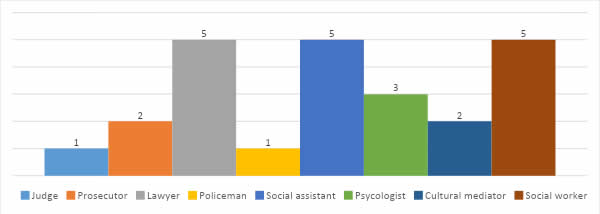
The research methodology combines a (i) desk-research – secondary data source (relevant national legislation, official reports, statistics, guides and other publications regarding unaccompanied minors); then validated by (ii) fieldwork interviews with professionals from the legal and social field – primary data source.
A semi-structured method was adopted for the fieldwork interviews.
Due to current Covid-19 pandemic interviews have been conducted in most of the cases virtually (Skype, Teams, Google Meet, Zoom or Whatsapp video calls).
From the subjective point of view, some preliminary clarifications about the target group are needed, in terms of definitions of “unaccompanied minors”, “children suspects or accused of crime” and “victims of crime”, adopted in the frame of the project:
An “unaccompanied minor” (UAM) is defined in the Article 2 letter (i) of the Council Directive 2004/83/EC of 29 April 2004 on minimum standards for the qualification and status of third country nationals or stateless persons as refugees or as persons, who otherwise need international protection and the content of the protection granted, as a “third-country nationals or stateless persons below the age of 18, who arrive on the territory of the Member States unaccompanied by an adult responsible for them whether by law or custom, and for as long as they are not effectively taken into the care of such a person; it includes children who are left unaccompanied after they have entered the territory of the Member States”.
A “Child as suspects or accused of a crime”, underage or turning 18 during the criminal proceedings, is highly protected « in order to preserve their potential for development and reintegration into society » [1] (except for those proceedings which are specifically designed for children that lead to protective, educative, or corrective measures, as recital 17 of the Council Directive 2016/800/EU on procedural safeguards for children who are suspects or accused persons in criminal proceedings provides).
“Children victims“ under the Victim’s Rights Directive ‘child’ [2] means any person below 18 years of age; while ‘victim’ means: (i) a natural person who has suffered harm, including physical, mental or emotional harm or economic loss which was directly caused by a criminal offence; (ii) family members of a person whose death was directly caused by a criminal offence and who have suffered harm as a result of that person’s death [3].
Concerning the professionals interviewed, in an initial phase, some informal consultation meetings with the identified stakeholder individuals and institutions, were conducted locally and followed the selection of the interviewees. The profiles of professionals are chosen depending on their direct or indirect supporting role towards unaccompanied minors involved in criminal proceedings, but also in their integration process in Italy.
Concerning the children involvement, the interviews with social professionals(social service providers) have led to the selection of some profiles of young adults suspect, accused or victim of crime; the experiences of the responsible staff from the reception centres from some areas in Sicily, as the first actors that interact with the children, have underlined that, they had to deal more often with unaccompanied minors victims of crime, especially of human trafficking, a particularly vulnerable category for which an interview could have exposed them to a risk of secondary victimization; while the experience from the social institutions, such as USSM, have underlined the judicial path of children suspects.
“Most of the unaccompanied children victims of human trafficking came from Nigeria; during the years the method of recruitment became well-known and has brought a protection team in different districts, to develop good promising practises, as shown from the successful model proposed in Catania, Sicily” [4]. During the last months it seems that the arrivals from Nigerian children have decreased, while it’s increasing the number of Ivorian arrivals, especially girls under 18 [5] In most of the cases, it seems that they are used to escaping and to be traced, so that the organisation and institution are still trying to understand the new flows and the change of methods.
The fieldwork focuses on the analysis of existing promising practises that “improve individual assessments and related assistance for unaccompanied children who are also victims of crime or are suspected or accused of a crime”.
The potential good practices identification process was based on the Italian legislation and existing strategies in the field:
- The existing practices on how to ensure support to unaccompanied children in criminal procedures (special focus – migrants);
- The existing judicial practices for ensuring child friendly justice, with main focus procedures with participation of unaccompanied children as suspects or accused of a crime.
These two steps provided insights of an analysis of the applicable legal framework and identified existing practices in criminal cases involving unaccompanied migrants children, both as victims or suspects; then of what are existing judicial trends and practices when it comes to criminal cases concerning unaccompanied children. The experiences shared through the interviews allowed us to identify strengths and weaknesses within the process of individual assessment and which potential problems have emerged in some areas of the country, especially in the South of Italy, towards the project’s specific target group. Collecting results from experts of different Italian regions (Sicily, Campania, Lazio) has helped to understand the extent of local practices being harmonised at national level. What resulted is a diversified approach diverging not just from region to region, but often among provinces.
Datasheet Research Participants
|
# |
Code | Gender | Profession | Date |
|
1. |
IT/J/01 | Female | Judge | 02/08/2021 |
|
2. |
IT/L/01 | Female | Lawyer | 11/02/2020 |
|
3. |
IT/L/02 | Female | Lawyer | 11/02/2020 |
|
4. |
IT/L/03 | Male | Lawyer | 11/02/2020 |
|
5. |
IT/L-G/04 | Female | Lawyer and Voluntary Guardian | 28/11/2020 |
|
6. |
IT/L-G/05 | Female | Lawyer and Voluntary Guardian | 15/12/2020 |
|
7. |
IT/M/01 | Female | Cultural mediator | 12/03/2020 |
|
8. |
IT/M/02 | Female | Cultural Mediator | 12/09/2020 |
|
9. |
IT/P/01 | Male | Prosecutor | 30/11/2020 |
|
10. |
IT/P/02 | Female | Prosecutor | 14/12/2020 |
|
11. |
IT/PO/1 | Male | Policeman | 16/01/2021 |
|
12. |
IT/PS/01 | Male | Psychologist | 31/10/2020 |
|
13. |
IT/PS/02 | Female | Psychologist | 11/04/2020 |
|
14. |
IT/PS/03 | Female | Psychologist | 11/09/2020 |
|
15. |
IT/SA/01 | Female | Social assistant | 01/08/2021 |
|
16. |
IT/SA/02 | Female | Social assistant | 24/12/2020 |
|
17. |
IT/SA/03 | Female | Social assistant | 22/01/2021 |
|
18. |
IT/SA/04 | Female | Social assistant | 25/01/2021 |
|
19. |
IT/SA-G/05 | Female | Institutional Guardian | 11/09/2020 |
|
20. |
IT/SW/01 | Female | Social worker | 24/12/2020 |
|
21. |
IT/SW/02 | Female | Social Worker | 15/12/2020 |
|
22. |
IT/SW-G/03 | Male | Social worker – Temporary Guardian | 24/11/2020 |
|
23. |
IT/SW-G/04 | Female | Social worker- Temporary Guardian | 18/11/2020 |
|
24. |
IT/SW-G/05 | Female | Social worker – Temporary Guardian | 24/11/2020 |
|
25. |
IT/MS/01 | Male | Young adult suspect of crime | 03/02/2021 |
|
26. |
IT/MA/2 | Male | Young adult accused of crime | 10/02/2021 |
|
27. |
IT/MV/01 | Female | Young adult victim of crime | 11/02/2021 |
1 Directive (EU) 2016/800 of the European Parliament and of the Council of 11 May 2016 on procedural safeguards for children who are suspects or accused persons in criminal proceedings.
2 Art. 2 co. 1 lett. (c ) of Directive 2012/29/EU of the European Parliament and of the Council of 25 October 2012 establishing minimum standards on the rights, support and protection of victims of crime, and replacing Council Framework Decision 2001/220/JHA.
3 Art. 2 co. 1 lett. (a) of Directive 2012/29/EU of the European Parliament and of the Council of 25 October 2012 establishing minimum standards on the rights, support and protection of victims of crime, and replacing Council Framework Decision 2001/220/JHA.
4 IOM, La tratta di esseri umani attraverso la rotta del Mediterraneo centrale: dati, storie e informazioni raccolte dall’organizzazione internazionale per le migrazioni (2017).
5 Central Directorate of Civil Services for Immigration and Asylum, Ministerial Daily dashboard Institutional data related to the phenomenon of landings and the reception of migrants at the facilities (March 2021).
Acronyms and references
|
AMIF |
Asylum, Migration and Integration Fund |
|
ASP |
Provincial Health Authority |
|
CFJ |
Child-friendly Justice |
|
CPIA |
Provincial Centres for Adult Education |
|
CPC |
Criminal Procedural Code |
|
CRC |
UN Convention of the Rights of the Child |
|
Children’s Guardian |
The institutional guardian has custody of an unaccompanied minor. The mayor or a counsellor of the municipality can be appointed as a guardian but only if there is a lack of available voluntary guardians |
|
The temporary guardian is the legal representative of an unaccompanied minor for a limited period of time and often coincides with the manager of the reception centre where the person resides |
|
|
A voluntary guardian is defined as an independent person who safeguards a child’s best interests and general well-being, and to this effect complements the limited legal capacity of the child . In Italy, guardianship is voluntary and not remunerated |
|
|
DDA |
Anti-mafia Investigation District Office |
|
DPR |
Presidential Decree |
|
EU |
European Union |
|
EASO |
European Asylum Support Office |
|
IOM |
International Organisation for Migration |
|
NGO |
Non-Governmental Organisation |
|
PTSD |
Post-traumatic stress disorder |
|
Secondary victimization |
It refers to behaviours and attitudes of social service providers that are “victim-blaming” and insensitive, and which traumatize victims of violence who are being served by these agencies |
|
SIPROIMI |
Italian System of Protection for Beneficiaries of International Protection and Unaccompanied Minors [since 2018] |
|
SISM |
Juvenile Services Information System |
|
Social assistant |
Social assistant is a person from a public office (USSM) charged of providing social service |
|
Territorial Commission |
The Territorial Commissions’ role is to grant recognition of refugee status to a requester. |
|
UAM |
Unaccompanied Minors |
|
UASC |
Unaccompanied or Separated Children |
|
USSM |
Social Service Office for Minors (the social service of the tribunal) |
|
UNHCR |
United Nations High Commissioner for Refugees |
|
Zampa Law |
Zampa law modified the procedures for social inclusion of unaccompanied children, in order to let the minors acquire autonomy |
Bibliography
-
AIDA, Statistics about asylum procedures (2020).
https://asylumineurope.org/reports/country/italy/statistics
-
Buffone G., Minori stranieri non accompagnati. La tabella delle novità” (2017).
https://www.altalex.com/documents/news/2017/04/27/minori-stranieri-non-accompagnati-la-tabella
-
Central Directorate of Civil Services for Immigration and Asylum, Ministerial Daily dashboard Institutional data related to the phenomenon of landings and the reception of migrants at the facilities (2021).
-
De Siena F.S., L’arte della cross-examination nel processo parti o di ideologia accusatoria: il controesame (2017).
-
Di Napoli E., Riflessioni a margine della nuova procedura di accertamento dell’età del minore straniero non accompagnato ai sensi dell’art. 5 della legge 47/2017 (2017). https://www.dirittoimmigrazionecittadinanza.it/archivio-saggi-commenti/saggi/fascicolo-n-3-2017/130-riflessioni-a-margine-della-nuova-procedura-di-accertamento-dell-eta-del-minore-straniero-non-accompagnato-ai-sensi-dell-art-5-della-l-47-2017/file
-
FRA, The age of majority (2017).
https://fra.europa.eu/en/publication/2017/mapping-minimum-age-requirements/age-majority
-
Gialuz M., Lo statuto europeo delle vittime vulnerabili (2012).
-
IOM, La tratta di esseri umani attraverso la rotta del Mediterraneo centrale: dati, storie e informazioni raccolte dall’organizzazione internazionale per le migrazioni (2017).
-
IOM, Handbook on Performance Indicators for Counter-Trafficking Projects (2008) https://www.iom.int/jahia/webdav/shared/shared/mainsite/published_docs/brochures_and_info_sheets/pi_handbook_180808.pdf
-
ISTAT, Autori e vittime dei delitti denunciati dalle forze di polizia all’autorità giudiziaria (2019)
-
Istituto del Garante Regionale dei Diritti della Persona, I minori stranieri non accompagnati. Guida pratica alla Normativa (2017).
-
La Placa S., Approvato il protocollo multidisciplinare dell’età di minori stranieri non accompagnati (2020).
-
Lelliott J., Italy’s ‘Zampa’ law: increasing protection for unaccompanied children (2018).
https://www.fmreview.org/sites/fmr/files/FMRdownloads/en/syria2018/lelliott.pdf
-
Long J., Tutela volontaria di minori stranieri non accompagnati (2018).
-
Lorenzetto E., Il diritto di difendersi indagando nel sistema processuale penale (2013).
-
Ministero della Giustizia – Direzione Generale di Statistica e analisi organizzativa, Movimento dei procedimenti; l’attività di definizione; i provvedimenti emessi (2020).
https://www.giustizia.it/giustizia/it/mg_12_2_6.page?previsiousPage=mg_1_8_1
-
Ministero del lavoro e delle politiche sociali- Direzione generale dell’immigrazione e delle politiche di integrazione, Report di monitoraggio (2019).
-
Ministero della Giustizia, Minorenni e giovani adulti in carico ai Servizi minorili – Analisi statistica dei dati (2020).
https://www.giustizia.it/giustizia/it/mg_1_14.page?facetNode_1=4_132&selectedNode=0_6
-
Rozzi E., The new Italian law on unaccompanied minors: a model for the EU? – EU Immigration and Asylum Law and Policy (2017).
https://eumigrationlawblog.eu/the-new-italian-law-on-unaccompanied-minors-a-model-for-the-eu/
-
Salierno R. and Bonafede M., I minori nel circuito penale a Palermo (2010). http://www.osservatoriopalermo.it/filepubblicazioni/report_USSM.pdf
-
Save The Children, Sviluppo di metodi transnazionali basati sui diritti del minore diretti alla prevenzione della criminalità minorile e alla promozione del reinserimento sociale. Italia, Grecia, Romania (2008).
http://images.savethechildren.it/f/download/01/01_manuale_just_metodi.pdf
-
Save The Children, Piccoli schiavi invisibili (2017).
-
Save The Children, Guida per tutori volontari di minori stranieri non accompagnati (2018).
-
Tamburini G., La tutela della vittima di reato: l’accertamento della condizione di particolare vulnerabilità (2018).
-
UNHCR, Unaccompanied and separated asylum-seeking and refugee children turning eighteen: what to celebrate? (March 2014).
 This project is co-funded by the European Union’s Rights, Equality and Citizenship Programme (2014-2020).
This project has been funded with support from the European Commission. This document reflects the views only of the authors, and the Commission cannot be held responsible for any use which may be made of the information contained therein.

This work is licensed under a Creative Commons Attribution-ShareAlike 4.0 International License.