

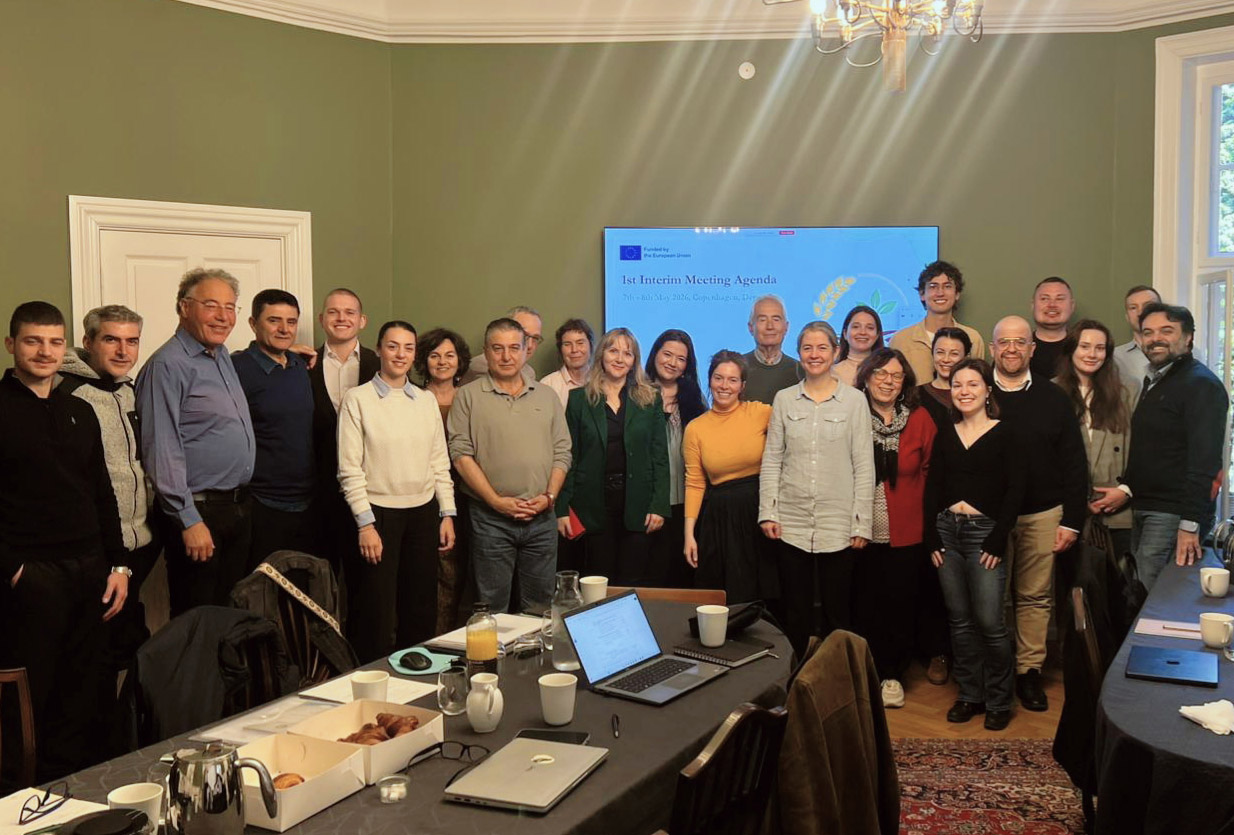
On 7 and 8 May 2026, the partners of the Horizon Europe project Crop MATCHING gathered in Copenhagen for the 1st Interim Meeting bringing together researchers, experts, and representatives from the agricultural sector across Europe. The two working days focused on tasks and deliverables due within the first reporting period (M1-M18). The objective of the Crop-MATCHING project is to select the best crop matching practices and ensure that smallholder farmers and foresters, families and communities benefit fully from research and practices, increase sustainably their incomes, vibrate their rural areas and empower their communities.
Under the coordination of Prof. Konstadinos Mattas (AUTH) and with the participation of EU Project Officer Tiago Freitas, the first day reviewed progress across WP1 (Requirements Elicitation) and WP2 (Information and Training Needs Analysis): from the construction of the multi-actor community and Practice Groups, to the drafting of national reports on best crop matching practices, through to the planning of the 1st European Policy Activists Exchange, scheduled for 9 September 2026 alongside the 194th EAAE Seminar in Crete. The second day addressed communication and dissemination activities (WP8) and managerial and administrative matters (WP11), closing with the meetings of the General Assembly and the Executive Management Board.
PRISM, as leader of WP4 Crop-MATCHING Digital Cloud Solution, presented the progress of the e-learning platform currently under development, which will bring together content produced across the project’s other work packages to deliver personalised training pathways for farmers and agricultural practitioners.
The consortium’s next meeting will be the 2nd General Meeting in Portugal (29–30 October 2026), which will also host the first Thematic Network meeting open to stakeholders and farmers.
Stay updated on the project at the official website: www.cropmatching.com

Funded by the European Union. Views and opinions expressed are however those of the author(s) only and do not necessarily reflect those of the European Union. The European Union cannot be held responsible for them.